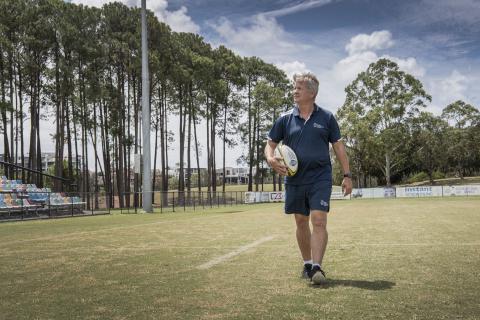
When Sean Hedger arrived at Bond University Rugby Club at the end of 2014, the Bull Sharks were struggling to find enough players to field two men’s teams.
This weekend, the General Manager of Rugby will watch four Bull Sharks teams play in Queensland Premier Rugby Grand Finals.
It gives Bond the second-highest QPR grand final representation of any club.
For a man who has poured years into building the club, the occasion carries plenty of meaning.
“When I came here at the end of the 2014 season, it was difficult finding 30 players to form two teams,” Hedger said.
“The Colts were separated from the seniors, and the club was struggling a bit.
“I put five hard years in to try to build it up.
“It’s nice to see something come from nothing and to have grown into what it is today…it’s a huge credit to the coaching staff and everyone at the club.”
Hedger’s own rugby story began more than 3000 kilometres from the Canal.
Growing up in football-mad Darwin, Hedger tried his hand at rugby league and AFL as a youngster before finding his place at halfback in union.
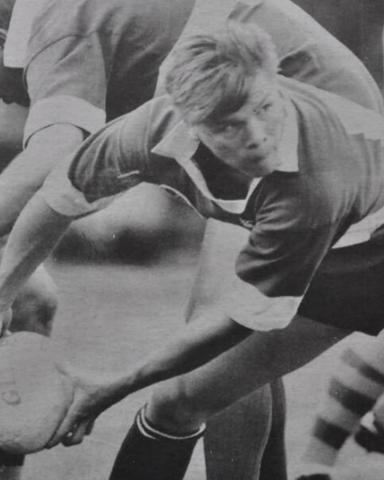
With his sights set on a career in sport, Hedger studied Human Movement Science (Sports Management) at Southern Cross University, although exactly where the degree would take him was initially unclear.
“I was an active kid in high school and wasn’t sure what I wanted to study at uni,” Hedger said.
“Someone suggested sports science and I was like, ‘A career in sport? That sounds pretty good to me.’
“I never really like the heavy scientific elements of the degree, it was the coaching side that I found enjoyable.
“One of my mates got a job with Rugby New South Wales and said, ‘mate, this is awesome…also, they’ve got a development officer role opening up and you should apply.”
Hedger landed the job in Orange, beginning a coaching journey that would eventually take him from regional New South Wales to professional rugby on both sides of the equator.
After a two-year tenure with the Queensland Reds Development Program, Hedger spent seven years working with top Japanese rugby clubs the Kobelco Kobe Steelers and Kyuden Voltex.
It was there that he learned a lesson that continues to shape his calm, deliberate leadership style today: sometimes less is more. “Every club over in Japan has translators and your ability to communicate is very dependent on your relationship with the translator,” Hedger said.
“Something it taught me, and I talk to coaches about this all the time, is that a lot of coaches talk too much.
“When you’re delivering instructions and they have to get translated, it takes twice as long to get the information across.
“If you speak for too long and then the translator communicates the message, the whole process is way too long.
“I worked out I had to scale back what I was saying and just go ‘bang, bang’ with the messaging.”
That clarity of communication has become a hallmark of Hedger’s leadership, but equally important is connection.
Rather than building the club around one voice, Hedger believes in creating an environment where players, coaches and staff feel ownership over its direction.
“I’m definitely a communicator and I like doing things together,” Hedger said.
“Cooperation and collaboration are really important in a football club and everyone needs to feel like they are part of the process.
“Connection is a bit of a buzzword these days because with our phones we’re all disconnected, but connection in a group is really important.
“If everyone's on the same page, you don’t have a group of people who go ‘My thoughts are better than his or hers.’
It’s ‘How I’m thinking may be different to the group, but the group is more important.’”
After five years helping establish Bond, Hedger returned to Japan with the Kintetsu Liners before another opportunity took him to one of Australian rugby’s most famous clubs, Sydney University.
He guided the Students to the 2022 Shute Shield premiership, but some of the moments he remembers most fondly have nothing to do with silverware.
“There’s a kid that came the rugby club there that I’m really proud of,” Hedegr said.
“Everyone told me he was this wonderful, talented kid but I just couldn't get connection with him.
“I found out a bit more about his background and that he had a few mental health issues, so I changed my approach.
“I didn’t try as hard to connect, but just talked about the game with him and slowly he became more comfortable.
“He ended up being such an important player in the group and eventually got a Waratah’s contract.”
Hedger’s ability to get the most out of young talent is starting to bear fruits for the Bull Sharks, who have the opportunity to complete a clean sweep of the Colts divisions.
Adam Fahey’s Colts 1 side will face Souths on Sunday, while Dan Smith’s Colts 2 outfit will meet Brothers on Saturday after Noah Lewis’ dramatic late field goal punched their ticket to the decider.
Hedger has been thoughtful in his coaching choices for the youngest Bull Sharks.
“Some clubs put young, enthusiastic coaches with their Colts,” Hedger said.
“But when you’ve got an inexperienced coach and young 18 and 19-year-olds, often the messaging doesn’t quite get through.
“Adam, Damon (Virtue, Colts 1 assistant coach) and Dan are all incredibly experienced.
“They know how to communicate with young men - what the important messages are, what’s a waste of time, and what’s going to get the most out of the group.
“The experience of those guys has had a massive impact.”
Hedger’s connection to the next generation of Gold Coast rugby extends beyond his job.
He is also father to 15-year-old boy-girl twins, with his daughter already showing promise on the rugby field.
Should her pathway eventually lead to Bond, she would arrive at a vastly different women’s program to the one Hedger watched take its first steps.
Bond’s Premier Women will chase a fifth consecutive QPR premiership this Saturday, continuing a remarkable rise built on the foundations of the Gold Coast’s strong rugby sevens community.
The Bull Sharks introduced their first women's 15s program in 2020, recruiting seasoned 7s coaches Lawrence Faifua and Setu Naseri to steer the ship.
“Lawrence's sevens program were a really well-organised, successful group,” Hedger said.
“So when it came time for Bond to have a women's program, it made sense to partner with them.
“When you watch our Premier Women play, you notice their speed – it makes sense that the genesis of the team came from sevens.”
Yet perhaps nothing illustrates Bond’s transformation better than the fourth Bull Sharks side heading to Ballymore this weekend.
Third Grade will also play for a premiership.
No one will be prouder than Hedger when all four Bull Sharks sides take to Ballymore in a few days’ time, but he is working hard to ensure the Bull Sharks’ legacy extends far beyond one weekend.
On semi-final weekend, an opposition figure approached him and asked how many Bond teams were still playing.
The answer was five.
Four of them won.
“They were like ‘Wow, you guys are turning into a powerhouse club now,’” Hedger said.
“It’s what I say a lot of the players – we want to be a powerhouse club, we want clubs to drive down the M1 going, ‘Oh this is going to be a hard day.’
“But you want to be at that level and then maintain it.
“We may be called a powerhouse in 2026, but if it doesn't get said in ‘27 or ‘28, we’re going to have to start all over again.
“But we're getting really close”.