
Country's embrace
How discovering her cultural identity strengthened
Keitha's purpose and belonging
Country's embrace
How discovering her cultural identity strengthened Keitha's purpose and belonging
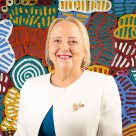
Most academics measure the University calendar in semesters, exams and graduation ceremonies. Professor Keitha Dunstan reads it differently — in the changing rhythm of Bond University’s trees: the red blaze of poincianas, the winter flowering of trumpet trees, and the jacarandas turning the campus purple as spring arrives.
It is a connection to nature she learnt as a child, long before she discovered her Aboriginal heritage.
And it is a way of knowing, being and doing that now shapes her work to embed Indigenous perspectives throughout the Bond University curriculum.
For Keitha, a Mandandanji woman and Bond’s Provost, the natural world has always been part of how she understands her place in it. She just didn’t have the language to explain why until much later in life.
As a child, she would sit beneath a tree with her grandmother, sisters, and cousins, yarning about flowers and birds. It was an ordinary part of family life, rather than a formal lesson in culture.
Looking back, she sees it differently.
“I was experiencing Aboriginal culture,” she says.
As a child, she would sit beneath a tree with her grandmother, sisters, and cousins, yarning about flowers and birds. It was an ordinary part of family life, rather than a formal lesson in culture.
Looking back, she sees it differently.
“I was experiencing Aboriginal culture,” she says.
That realisation has become a powerful thread in how she approaches education. Indigenous knowledge is not something that belongs only in a history lesson or a dedicated cultural subject. It is a way of understanding relationships — with people, place and the natural world — that can powerfully enrich learning.
At Bond, she is helping turn that understanding into practice.
The University’s Indigenous Education Strategy sets an ambition to make Aboriginal and Torres Strait Islander knowledge and perspectives a more integral part of the university community. While Indigenous ways of knowing, being and doing are already embedded in the core subjects and some programs, Keitha wants to see that work extend across all curriculum.
The challenge is helping academics see how those perspectives are relevant to their own fields, rather than treating Indigenous education as an add-on that is the responsibility of a handful of specialists.
Keitha knows that challenge well. An accountant by background, she recalls how educators in business initially wondered how Indigenous knowledge could fit into a first-year accounting subject. Her answer was practical: Indigenous organisations and start-ups are part of the business landscape, and graduates may go on to work for them or provide professional advice. Understanding the people and communities behind those organisations is part of being prepared for the workplace.
The same principle applies to health. Students studying medicine and allied health need more than technical knowledge; they also need to understand the lived experiences that shape a patient’s access to suitable care.
“There’s a lot of mistrust of white authorities and institutions, including things like hospital and Government,” Keitha says of some regional Indigenous communities.
“They don’t trust the establishment because there is a long history of being excluded because of prejudice and racism.”
That history can have consequences in the consulting room. Keitha says health students need to learn how to communicate with Indigenous patients and provide support in ways that recognise those experiences, rather than assuming every patient approaches the healthcare system with the same expectations.
Bond’s First Nations health education is one of the areas where this work is already well established, in part because medical and allied health accreditation requirements place a strong emphasis on Indigenous education. Keitha wants that level of cultural understanding to become a more consistent feature of the wider university experience.
Research offers another opportunity. Academics, she says, should consider the implications of their work for Aboriginal and Torres Strait Islander people, even when Indigenous communities are not the primary focus of a study. A finding about preventative healthcare, for example, has limited value if the proposed solution cannot be delivered in the regional communities that need it.
For Keitha, embedding Indigenous perspectives is not about adding a token reference in a subject outline. It is about asking better questions, considering whose experiences are represented and understanding how knowledge translates into the lives of different communities.
That approach sits within a broader strategy built around cultural respect, relationships, education and support for Indigenous students and staff.
Bond’s Becoming Culturally Aware microcredential is one way the University is building cultural capability among staff and students. Developed in partnership with the Yugambeh Region Aboriginal Corporation Alliance (YRACA) and led by Uncle John Graham and Aunty Mary Graham, the program helps participants deepen their understanding of Aboriginal and Torres Strait Islander culture and history. The partnership has also created a commercial opportunity for YRACA which is now distributing the micro-credential more broadly.
The University has put in place an Indigenous strategy and is currently implementing its Innovate Reconciliation Action Plan. Cultural respect and collaboration with Indigenous communities are central to that strategy.
The importance of Indigenous culture and heritage is celebrated at the University through welcomes and acknowledgements at major events, the celebration of important cultural events such as NAIDOC Week and Reconciliation Week, and the leadership of Bond University Elder Uncle John Graham. Cultural celebrations provide non-Indigenous staff and students the opportunity to share in the richness of Indigenous heritage.
These commitments are not confined to the classroom. Bond’s Indigenous Workforce Strategy is another key initiative. It aims to create a workplace where Indigenous people and cultures are welcomed, valued and supported. That includes mentoring, professional development, stronger staff networks and pathways for Indigenous scholars to build academic careers.
For Keitha, this whole-of-university approach matters because education is about more than what happens between the covers of a textbook. It is also about whether people feel they belong, whether their knowledge is valued and whether they can see a future for themselves.
It is a lesson she understands personally.
Keitha was 12 when she discovered she was Aboriginal. Looking through a family photo album, she saw a dark-skinned woman she did not recognise and asked her mother who she was.
“That’s my grandmother,” her mother replied, before telling her not to let her grandmother know she had discovered the truth.
The family history behind that exchange was shaped by Queensland laws that controlled where Aboriginal people could live and work, whom they could marry and how they could associate with their own families.
Keitha’s great-grandmother had spent much of her childhood and young adulthood working as a domestic servant. An exemption from the state’s Aboriginal protection legislation gave her greater independence, but came with a condition that she no longer associate with other Aboriginal people.
The consequences reached across generations. Family members were separated, and connections that might otherwise have been passed down were lost or obscured. Like most Aboriginal families, Keitha’s family was impacted by “The Stolen Generation”, with children removed from their families.
Even when people know they have Aboriginal ancestry, tracing their family and Country can be difficult.
Keitha was fortunate to have birth certificates documenting her family line through the women. For others, the paper trail can end abruptly. Many Aboriginals did not have a birth certificate, and for those that did, the father was often not recorded because relationships recognised under Aboriginal custom were often not recognised or recorded in government documents.
If a child was removed from their family and adopted under a different name, finding their birth family could become harder still. Some people may grow up without knowing their Aboriginal heritage or where their ancestors came from.
Keitha’s own grandmother lived to almost 100. Before her death in 2019, she was reluctant for Keitha to publicly identify as Aboriginal, concerned about the consequences it might have for her career. Keitha respected that wish. After her grandmother died, she began reconnecting with her Mandandanji family and community, eventually helping to establish an Aboriginal corporation.
The process brought its own questions. Keitha had enjoyed a good education and built a successful career without people knowing she was Indigenous. She wondered what identifying earlier might have meant, and whether her lack of connection to culture somehow diminished her claim to it.
But the memory of her grandmother beneath the tree offered a different way of looking at her childhood. Culture had been present in the time they spent together, in the stories about the natural world and in the values she carried into adulthood. She had not necessarily been missing culture; she had not yet understood what she had been given.
As she began spending more time with other Aboriginal people and reconnecting with her community, she describes a feeling of recognition.
“It’s like, oh, I’m home.”
Keitha also understands how important it is to have people who can help others find their way through that journey. She says she receives support from Uncle John and staff of the Nyombil Centre herself, despite now being one of the University’s senior leaders.
That cultural support is central to the role of the Nyombil Centre, established in 2012 as a home for Bond’s Indigenous community. Alongside academic guidance, it provides a place for students to connect with one another, build relationships with the local community and explore their cultural identity.
Uncle John and the Nyombil team can help students who are trying to understand their family histories and connections to Country. Sometimes those connections can be difficult to trace and it can be a painful experience given the multi-generational trauma caused by “The Stolen Generation”. Even when the answers cannot be found, Keitha says, the University can still offer something important: a sense of welcome and belonging.
At Nyombil, students place a dot on a map to show where they come from. Each mark represents an individual story, but together they make the breadth of the community visible.
Bond does not have a large Indigenous student population, but Keitha says it consistently ranks among the top few universities for Indigenous student success. She believes the Bond model — with its small classes, individual support and pathways into higher education — can make a real difference, particularly for students who have not always had access to educational opportunities.
Some Indigenous students arrive through a Bond College pathway, including mature-age students who return to study after spending time in the workforce. The University’s approach is to recognise that students may need different kinds of support without defining them by the challenges they have faced.
Financial support is another important part of the picture. Keitha says scholarships are particularly important because some Indigenous students and families have had little experience of home ownership or borrowing to invest in a future. Where debt has been associated with high-cost credit and financial hardship, taking on a fee help debt can feel daunting.
“They’re very scared of debt,” she says.
For a student weighing up the cost of a degree, that fear can become another barrier to university. Scholarships can help ease the financial burden and make higher education feel possible, while the support of the Nyombil Centre and the wider Bond community helps students navigate the experience once they arrive.
Keitha knows how powerful it can be when someone opens a door that a family has not previously imagined walking through.
When she was in Year 11, a teacher told her she should become a professor of economics. University had not been part of her family’s plans; her father expected her to join the family business as a truck driver.
“I had never thought of going to university,” she says. “Nobody in my family had ever thought of going to university.”
The teacher did more than encourage her. Keitha recalls that the teacher went to her home and spoke with her parents for about an hour and a half. Afterwards, her father agreed she could give university a try, with the option of returning to drive trucks if it did not work out.
“It was a really good incentive to do well at uni so that I didn’t have to drive trucks!” she says.
Keitha went on to build an academic career. Her younger sister later completed a PhD, and seven of her parents’ nine grandchildren have graduated from university. They all now have successful careers in their chosen fields, including medicine, engineering, social work, academia, administration, and military intelligence. Keitha is proud to have been a role model for the family.
Once someone in a family has shown what is possible, the next generation can begin to imagine a different future.
“You can’t be what you can’t see,” Keitha says.
“One graduate at a time is going to make the difference.”
It is one reason Bond’s sense of belonging matters so much to her. And she believes the University has found a distinctive way to foster that feeling — one that reaches beyond the Indigenous community itself.
“You can’t be what you can’t see.”
At a recent alumni dinner, Keitha was talking with Uncle John and Auntie Mary Graham about the emotion she sees when graduates return to Bond. The familiar phrase “Once a Bondy, always a Bondy” captures that enduring connection, but Auntie Mary offered another explanation.
For Aboriginal people, she reminded Keitha, people belong to Country; Country does not belong to them. The campus sits on Kombumerri Country, and the affection graduates feel for Bond is also, in a deeper sense, an affection for the place and its people.
Auntie Mary told Keitha that students’ fondness for the University meant they had connected to her Country and had been embraced by her ancestors. She asked Keitha to pass on a message to Alumni: they had the blessing of her ancestors.
Keitha believes this connection to place is part of the “magic formula” behind Bond’s Indigenous student success. The feeling of belonging is not reserved for Indigenous students; it is something the University offers to everyone.
And perhaps that is the wider purpose of embedding Indigenous ways of knowing, being and doing into education. It asks students and staff to look beyond their immediate discipline, to understand the histories and relationships that shape the world around them, and to recognise the knowledge held by the communities in which they live and work.
Sometimes that learning begins in a lecture theatre. Sometimes it begins beneath a tree, listening to a grandmother talk about flowers and birds.
And sometimes, as Keitha discovered, the lesson has been there all along.
Original thinking direct to your inbox

Stories from Bond