By Assistant Professor Melanie Jackson and Senior Teaching Fellow Eva Teng
Teaching Legal Writing in the Age of AI: What First-Year Law Students Still Need to Learn
With spellcheck, Grammarly, and generative AI tools available at the click of a button, one might assume that legal writing has become easier. Yet many first-year law students continue to struggle with the fundamentals of legal writing. While technology can assist with drafting and editing, it cannot replace the skills required to analyse legal problems, evaluate sources, construct arguments and communicate with precision.
Many students encounter difficulties when first learning legal writing. Legal writing differs significantly from the persuasive, creative and analytical forms of writing commonly encountered in secondary education. As a result, students often rely on writing strategies that may have served them well at school but are less effective in a legal context. They may also struggle to identify exactly what a legal question is asking and how to structure an appropriate response. In addition, students must learn to navigate unfamiliar legal terminology, conventions, and citation requirements unique to legal communication.
This blog post explores some of the most common challenges faced by first-year law students from the perspectives of a law teacher and a legal writing tutor. It also offers practical strategies that educators can use to support students as they develop their legal writing skills.
Heavy reliance on AI Tools
There is a growing assumption among students that tools such as Grammarly, ChatGPT and built-in spellcheckers are sufficient for proofreading and editing their work. While these technologies can be helpful, they do not always account for context or discipline-specific conventions. As a result, students must critically review any changes suggested by these tools rather than accepting them automatically. While the tools may improve the presentation of an assessment task, they do not necessarily enhance the student's underlying writing ability. This becomes particularly apparent in closed-book invigilated assessments, where students must rely on their own legal writing and analytical skills without technological assistance. Delegating cognitive tasks to external tools rather than performing them independently is known as Cognitive offloading. When writers outsource too much of the reviewing and editing process to AI, they engage less deeply with their work and miss valuable opportunities to develop their writing skills. Over time, this can reduce confidence in self-editing and weaken their writing and editing abilities.
The risks associated with over-reliance on AI tools are no longer merely theoretical. Reports have emerged of students facing academic misconduct investigations after inappropriate use of Grammarly, while courts and educational institutions have increasingly scrutinised the use of generative AI in academic settings. Scholars have also identified a range of ethical and practical concerns associated with AI-assisted writing, including fabricated citations, inaccurate content and diminished engagement with the writing process. These concerns reinforce the importance of students developing their own proofreading, editing and legal writing skills rather than relying solely on technology.
Rather than asking AI tools to rewrite or proofread an entire piece of work, students should be encouraged to use them as learning tools. For example, AI may be used to identify unclear sentences, highlight recurring error patterns or explain citation rules, while leaving the task of revising and editing to the student.
Time Management
Procrastination, distractions and overcommitment are common factors that lead to ineffective time management. In a digital world where notifications, social media, and competing priorities constantly demand our attention, it can be difficult for students to focus on one task for an extended period.
These challenges can have a significant impact on legal writing. Students are often balancing study, work, family responsibilities and extracurricular commitments, making it difficult to devote sufficient time to assessment preparation. Yet effective legal writing requires much more than simply sitting down and writing. It involves understanding the task, conducting research, planning a response, drafting, revising and editing, and proofreading.
When students leave assignments until the last minute, it is usually the planning and editing stages that are sacrificed. As a result, their work may demonstrate limited analysis, weak structure or insufficient engagement with the relevant legal authorities. This can lead to lower marks, not necessarily because students lack ability, but because they have not allowed themselves enough time to fully engage in the writing process.
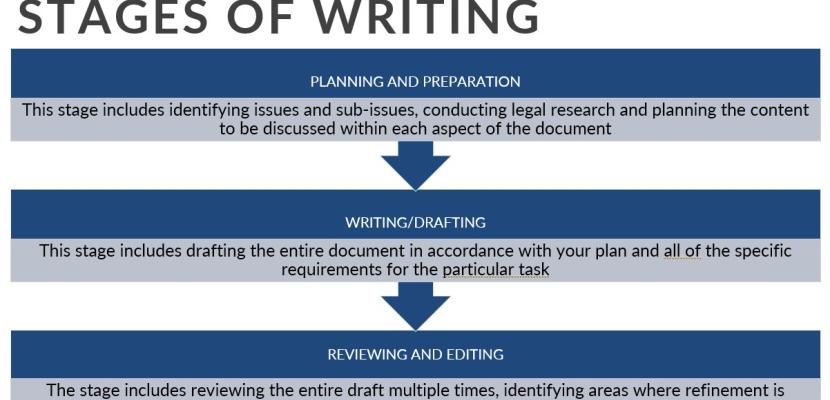
The various stages of legal writing are illustrated in the figure below. Developing an understanding of these stages early in a student's law degree can help them approach assessments more strategically and avoid the common pitfalls associated with last-minute drafting.
*Source: Melanie Jackson (teaching materials 2024)
Legal writing is not a skill that can be mastered in a single semester. Rather, it develops progressively throughout the students’ program of study as they engage in research, drafting, feedback and revision. The goal for first-year students is not perfection, but the development of effective habits that will support their growth as legal writers.
Unfortunately, many students undermine this process through poor time management. Assignments are often treated as tasks that can be completed shortly before the due date, leaving little time for planning, reflection, editing or proofreading. Although educators cannot control when students choose to begin their assignments, they can implement teaching strategies that promote early engagement with assessment tasks. Draft submissions, formative feedback opportunities and educational technologies such as Cadmus can provide valuable insights into student writing behaviours and help identify students who may be at risk of falling behind. Likewise, integrating legal skills, research, and library activities into weekly learning experiences encourages students to begin the research and planning stages of assessment earlier, reinforcing the structured approach to legal writing outlined above.
Referencing
Referencing is a fundamental component of legal writing because it allows students to demonstrate the depth and quality of their research, support their legal arguments and engage critically with legal authority. The current referencing style used in Australian law schools is the Australian Guide to Legal Citation (AGLC 4th ed), which differs significantly from other referencing systems that students may have encountered, such as APA. Rather than relying primarily on in-text citations and a reference list, legal writing uses footnotes as an integral part of legal analysis and scholarship.
Many first-year law students find this transition challenging. A common tendency is to spend considerable time recounting the facts of cases or describing what occurred, with relatively little attention paid to analysing the legal principles that emerge from those authorities. Students often struggle with the idea that a source can be cited as authority for a proposition without requiring a lengthy explanation of the entire case. Similarly, many students are surprised to learn that every reference to an authority requires a corresponding citation, even where the same source has been cited previously.
Referencing difficulties often extend beyond formatting rules. Students may be uncertain about when to cite, how much authority is required to support an argument, or how to integrate sources effectively into their analysis. As a result, referencing is not simply a technical exercise but an important legal skill that supports good scholarship and persuasive legal writing.
While there is no substitute for engaging directly with the AGLC rules, many new law students, particularly those who are visual learners, benefit from seeing examples of referencing in context. At Bond University, for example, students are provided with an AGLC in Context resource that demonstrates how citations are used within legal assessment tasks, helping them see the relationship between legal analysis and referencing in practice.
Lack of referencing can also lead to more serious issues such as academic misconduct or poor scholarship. There is evidence that new students often engage in poor scholarship because they are stressed, unsure or uneducated around referencing. Over trust in AI tools often leads to hallucinations and incorrect citations. The Queensland Supreme Court recently issued practice directions on the accuracy of references in legal submissions, suggesting that this is not just a problem affecting students but the profession as well.
Educators can further support students by embedding referencing instruction into assessment preparation rather than treating it as a standalone skill. Library workshops, citation exercises and opportunities to engage with worked examples can assist students in developing confidence with legal referencing. Introducing students to reference-management tools such as EndNote or Zotero may also encourage more effective research practices and help them develop organised systems for managing sources and for storing their research history in the event of any academic misconduct concerns.
Diverse Learning Needs
Legal writing tutors frequently work with students who have diverse learning needs. Students with ASD, ADHD, dyslexia, dysgraphia and other specific learning disorders often bring valuable perspectives and strengths to legal study, but they may also encounter barriers when completing the substantial reading, writing and editing tasks required in law school. These challenges extend beyond spelling and grammar and often involve differences in attention, working memory, information processing and self-monitoring.
Such students may benefit from accessible document design, including clear fonts, appropriate spacing, and uncluttered layouts. For example, sans fonts such as Arial and Verdana have been found to be better for students with ADHD than the more geometrically uniform letters in fonts like Times New Roman. If educators can provide flexibility in formatting, it can improve readability and reduce barriers for some students with learning differences. If the assessment task prescribes a particular font, some students might find it easier to write and edit their work in their preferred font before converting it before final submission.
Simply telling students (particularly those with ADHD) to “proofread more carefully” generally doesn’t work. Educators may wish to release editing checklists to assist students with the editing process. For example, educators can encourage students to examine the stages of their legal writing and pose specific questions, such as those below, to guide their proofreading.
- Legal Analysis – Did I answer the question? Is my reasoning complete? Does my conclusion follow my authorities?
- Structure – Is the argument logically sequenced? Have I followed the recommended structure/template provided?
- Authority – Is every proposition supported? Are my sources reliable and authoritative? Are all my references complete? Pinpoint references included?
- Expression – Are my sentences clear and concise? Are there any unnecessary words or phrases that are ambiguous or confusing?
- Citation and referencing- Are all of my footnotes complete? Have I checked if a bibliography is needed? Have I fixed up all subsequent references?
Legal writing tutors can also help students identify recurring error patterns across multiple assessments. For some students, these patterns may include omitted words, incomplete citations, lengthy sentences, issues with paragraph structure or missing/incomplete tasks. Encouraging students to develop a personalised proofreading checklist can transform proofreading from a vague task into a targeted and manageable process.
Ultimately, effective support for students with diverse learning needs involves making the legal writing process visible. Explicit instruction in planning, proofreading, editing and self-monitoring can help students develop the skills required for legal study and professional practice. While some students may require additional support, many of these strategies benefit all students and contribute to a more inclusive legal education.