From Courtroom Dreams to Climate Questions
What does it mean to start again without starting from scratch? Dr Hoda Asgarian’s journey invites us to reflect on resilience, reinvention and the experiences that give our professional lives purpose.
By Dr Hoda Asgarian
For as long as I can remember, I wanted to be a lawyer. Reading American legal thrillers, I imagined becoming one of those formidable advocates who could change everything with the right argument. Then I became a lawyer in Iran. The novels had omitted some jurisdictional differences.
As a woman, I did not always have the authority I had imagined. But my mother was a lawyer. Watching her, I thought: if she could do it, so could I. Persistence was something I learned at home. By 24, I had completed two master’s degrees. My father’s response was, naturally: “So, Hoda, when will you do your PhD?” I informed him that I was not a studying machine. I wanted to work. After a year of intensive preparation for Iran’s demanding bar entrance examination, I finally became the lawyer I had wanted to be.
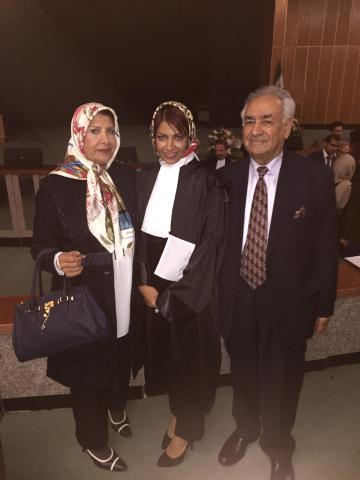
Teaching arrived less deliberately. I had learned several languages but maintaining them without daily use was difficult. I kept enrolling in courses, only to be placed at their highest level. Eventually, an institute suggested teaching: I could share my knowledge while keeping my language skills alive. Teaching? Surely not my thing. Still, I completed my TESOL qualification and gave it a go. My carefully planned legal career had acquired a rival. Apparently, I had confused “not my thing” with “haven’t tried it yet”. For approximately fifteen years, I practised law while teaching English, including to university students. Both brought fulfilment: solving a legal problem and seeing something click for a student each gave me a reason to love my work. I reached career goals that once seemed distant, including working at Unilever. Yet I found myself asking: what next?
Climate change increasingly occupied my thoughts. Legal practice had sharpened my interest in responsibility; experience made me question how fairly its burdens were distributed. My PhD compared climate change mitigation strategies in Iran and Australia through the lens of global climate justice. Eventually, I told my father: “I think the time you’ve been waiting for has arrived.”
I saw his happiness. But by the time my acceptance came, COVID-19 had taken him from us.
I began my PhD later in life, leaving an established career to start again in another country. Experience came with me, but professional networks and belonging needed rebuilding. Researching and teaching in my second language added another challenge. In Australia, I continued teaching, now in law, bringing together two fulfilling parts of my professional life.
As an only child, distance from my family could feel especially heavy. During a university teaching development session, my phone filled with missed calls. Messages repeated: “War has started.” I stepped outside and called my mother. No answer. Reports indicated that the area around our home had been struck. For nearly two months, communication disruptions made contact uncertain. I continued researching and teaching, holding on to the future I was building. Watching my people suffer through war and failures of governance was painful. Iran carries a rich inheritance of poetry, scholarship, art and debate. My Iranian identity is distinct from the regime governing my country. I am proud of that heritage and recognise its influence in my resilience: my mother’s example, my family’s commitment to education, and their determination despite uncertainty.
These experiences sharpened my research questions: whose circumstances are recognised, whose choices are constrained, and what does justice require when people begin from unequal positions?
I completed my thesis within three years. I wish my father could have seen it. I know how proud my family is.
Starting again involved sacrifice and risk. It was one of the best decisions of my life. My research now explores sanctions, climate obligations and ocean governance. I hope to develop that work within the Bond community where I have found belonging as a researcher and teacher. As a founding member of Bond’s new Centre for Climate Action Research, I am excited to help shape its work alongside colleagues, building on my research on climate justice, sanctions and international law.
My advice to prospective doctoral students? Leave room for the journey to change you. I once insisted I was finished studying. My father, I suspect, would have enjoyed the last word.
And where do I see my future? Once a Bondy, always a Bondy.