
People power
Julia is helping Queensland organisations understand what it takes to keep the people they rely on


People power
Julia is helping Queensland organisations understand what it takes to keep the people they rely on


When Julia Wicker arrived in Australia from Germany in 2018, she wanted to work on her English skills. Her sister suggested volunteering to meet people, have more conversations, and improve fluency. So Julia began volunteering with the Swell Sculpture Festival, the Gold Coast Hospital Foundation, and Bond University throughout her studies in communication and project management. Most recently, she’s been assisting Motherhood Village.
“Volunteering makes you feel good and has many benefits. As you’re helping others, you get to know more people, and it builds your own networks and opportunities,” Julia says. “It’s very reciprocal.”
But while volunteering plays a critical role in Queensland’s social and economic fabric —contributing more than $117 billion annually — participation across Australia is declining. For organisations built on goodwill and human connection, it’s a shortfall that has real consequences.
This challenge sits at the centre of Julia’s doctoral research at Bond University. Her PhD explores how volunteer organisations can better shape their ability to attract, support, and retain volunteers.
“Volunteers are extremely important and my research aims to help us better understand that downward trend of participation, as well as to inform organisations and policymakers of strategies to address it,” says Julia.
"My research aims to help us better understand that downward trend of participation..."


Turning initiative into opportunity
Julia attended online training and networking events with Volunteering Queensland (VQ) to learn more about volunteering and their work. When an in-person opportunity came up, she decided to make her own introduction.
“I remember feeling so nervous on the day because introducing myself, going to networking events, is just not my world. But I decided to do it anyway — I had nothing to lose, and potentially so much to win,” she says.
Julia’s initiative led to a volunteering role, which was then formalised into a Bond University PhD Industry Internship, supervised by Assistant Professor Dr Alexander Lang.
“For me, it means double mentorship. I have an academic mentor in Dr Lang, who I’ve learned so much from in the research space. And then I have Rikki Anderson from VQ as my industry mentor, who has enabled me to work on so many important projects.”

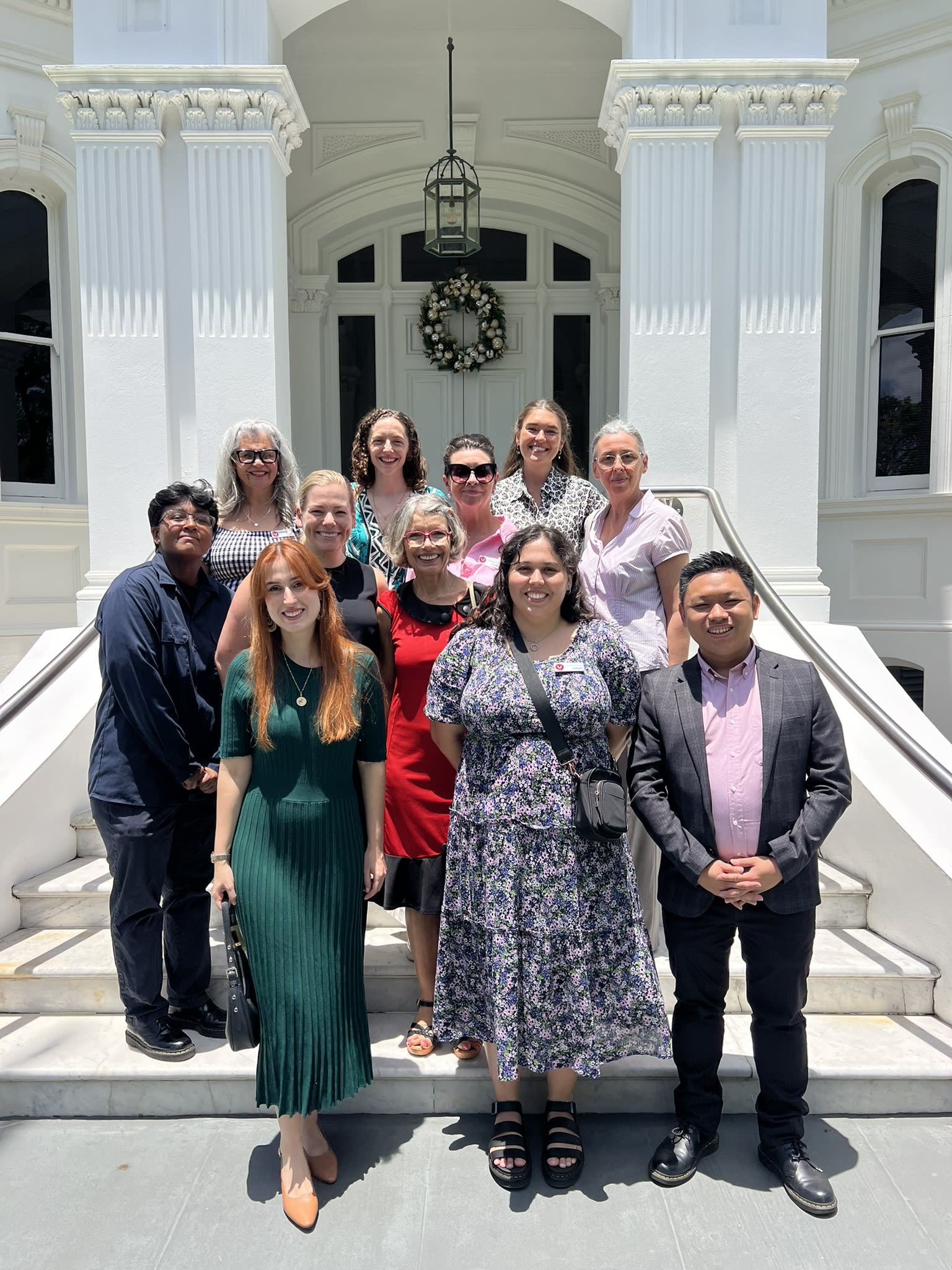
Julia with her colleagues from Volunteering Queensland.
Julia with her colleagues from Volunteering Queensland.
A multi-method approach
Through her industry engagement and work with VQ, Julia’s learned not every volunteer organisation has a decline in participation. “I want to look at what makes them so special,” Julia explains.
“How can they survive in an environment that seems to be so challenging? And what can other organisations learn from that?”
Julia’s research will include a scoping review to map data on organisational volunteer demand and supply; a quantitative study with volunteer-involving organisations; and a qualitative case analysis on selected organisations in a specific service area.
“My plan is to build a model specific to that volunteering service area, then seek industry feedback through a working group of sector experts,” she says.
“Based on that, we can develop training, information resources, and provide more context for organisations that struggle, to help them increase their volunteer numbers.”
Research shaped by lived experience
Like his PhD candidate, Assistant Professor Dr Alexander Lang brings personal experience of volunteering into the research. After arriving in Australia from Germany in 2020, he joined a range of educational, community — and even beekeeping — volunteering organisations to meet new people and build local connections.
“I had negative experiences which disappointed me, both in how I was treated and how the volunteering journey worked generally,” Professor Lang says.
“The resilience of people in volunteering spaces was very low, people were coming in and then leaving. There was a lot of fluctuation.
“These organisations put so much effort into finding new members. If the same effort had gone into keeping volunteers engaged, it would have been far more effective.”
That insight drives his enthusiasm for Julia’s project. He believes she is uniquely positioned to tackle the problem, combining academic rigour with genuine commitment to community impact.
“Julia likes to help others, it’s a big part of who she is,” he says.

Building evidence for sector-wide change
Project Manager at VQ, Rikki Anderson, says Julia’s research has already delivered tangible outcomes, helping to develop VQ’s new survey tool, the Voice of the Volunteer Survey, and the creation of a sector-first research framework, scheduled for approval by the organisation’s Research Advisory Committee.
Once implemented, the framework will provide a structured, evidence-based foundation for how VQ plans, advocates, reports, and engages with government and the broader sector.
“It will inform our strategic plans, our advocacy work, our training and development calendars, and the work plans we negotiate with government for funding, reporting, and impact,” Rikki explains.
“It gives us a far more strategic and consistent approach.”
For VQ, the partnership with Bond comes at a critical moment. With volunteer participation declining, the organisation is focused on building a stronger evidence base to guide decisions and policy positions.
“Having that depth of research and evidence through our partnerships with institutions like Bond University helps ensure we’re steering the sector in the right direction,” Rikki says.
Research at Bond
At Bond University, research is defined by long-term collaboration and its capacity to deliver value beyond the campus. Deputy Provost Research, Professor Michael Kimlin, says industry-based research, like Julia’s, allows partners to integrate rigorous academic insight into their work.
“Their work programme can be embedded with a high level of research that may not have otherwise been financially feasible,” he says.
“Or, in some cases, organisations may not have realised how relevant research could be to their work until they see the value it adds to their workforce, their products, and their customers.”
Professor Kimlin emphasises research success at Bond is measured through outcomes created together.
“We measure success through relationships,” he says. “By placing academics and students within organisations and working through co-design, co-delivery and co-reporting, we create outcomes that make a real-world difference.”


Original thinking direct to your inbox

Stories from Bond