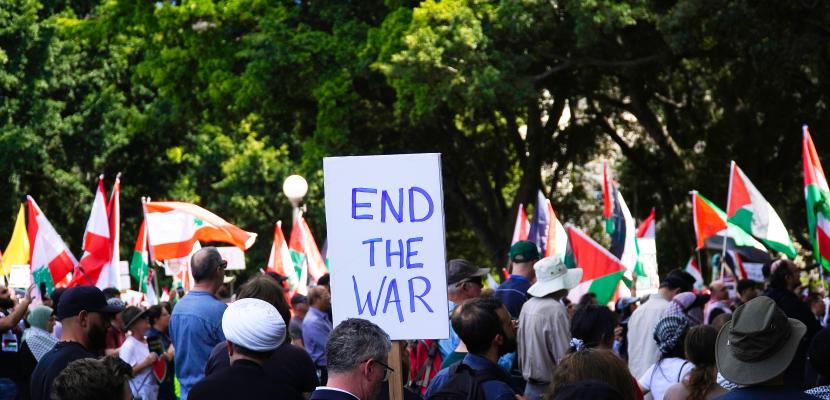
Constitutional law expert Professor Anthony Gray discusses Queensland becoming the first Australian state to ban the use of the phrases "from the river to the sea" and "globalise the intifada".
Q: Free speech advocates have raised concerns about these new laws enacted by the Queensland Government and we’ve already seen them lead to arrests – one person for wearing a T-shirt with the banned phrase and another who gave a speech they specifically stated was to educate listeners about the new laws. What is your take on this?
Professor Gray: Yes, there is an exemption that relates to the use of that expression for purposes of education, so that person may have a defence under that provision if they are able to demonstrate that. But I think it highlights the dangers of seeking to criminalise speech.
It’s very unusual for legislation to single out particular words. We're used to legislation in Queensland about incitement of hatred or violence, and laws are usually framed at that level of generality.
But to use specific words and to say that the expression of that particular phrase is criminal, that really is a few more steps along a path. And I understand that there may be a constitutional challenge brought to this legislation on the basis of the implied freedom of political communication we have in Australia.
Q: The explicit nature of these laws has been perceived as a very political decision, which is not necessarily uncommon, but is this first time we've seen legislation go this far in a democracy like ours?
Professor Gray: That's my understanding. I don't recall any other legislation that specifically bans the use of phrases. We've had banning symbols, but the expression of phrases, I think, is unprecedented. And to your point about the politics, I think that this is a highly politicised response.
We all know that the question of anti-Semitism is very important in our community. I think most right-thinking individuals agree that we need to take serious action to respond to anti-Semitism, but we differ on what are the best ways to go about that. I believe any education that we can do, any ways that we can improve understanding among different cultures and races and religions, all of that is really positive.
I don't personally believe that banning the expression of particular phrases will achieve anything in terms of curbing anti-Semitism. Banning a specific phrase, even if someone chooses not to use it, doesn’t mean they don't still believe it. So you're not actually addressing the problem.
It does seem as if it's window dressing, if I may say, and being seen to be doing something, maybe responding to pressure groups, but not actually addressing the problem that we all agree exists.
Q: These phrases, and the intent behind them, are also a matter of interpretation that differs among various groups and individuals. How do we rely on the law to make the decision on whose interpretation is the ‘right’ one?
Professor Gray: I think that, again, reflects the difficulty when you seek to prohibit speech and expressions and, indeed, logos because some of them are inherently open to interpretation.
In law, we understand that language can have many different meanings.
Take the word ‘consideration’. We all know what that means in general language, but in law, it has a particular meaning. if I use the word ‘consideration’ talking about contracts, I mean a particular thing. But someone else who hears that actually understands it to mean something different.
I've considered those particular phrases to which you refer, and yes, my understanding as well is that it is open to different interpretations, and whilst some groups may view it as being threatening and inciting violence, others may not. So the meaning of those words is contested, which really means, in my view, that's not an area in which the law should go.
It's not a precise analogy by any means, but it's interesting to consider the swastika. Because we often associate the swastika with Nazism, and of course, we all agree that Nazism is a horrible evil, and we all acknowledge the terrible atrocities committed under that symbol in World War II. However, that symbol did not always represent Nazism. It may have religious overtones in entirely different manner – Hindusim, for example. So that's another example of where these things often have contested meanings, multiple meanings, and again, it makes it dangerous for legislators to go there.
Q: It seems like the law's role is better played in determining intent. That it doesn't necessarily matter what the specific words or phrases are, but the intent behind their use.
Professor Gray: Yes, that's commonly a question that a judge would consider - whether there is evidence of intent. And often intent is associated with criminality; that we generally require that certain mental element before we impose potentially serious criminal sanctions on someone.
What about language – if someone has these phrases written on their shirts in, say, Arabic or in another language, how do they police that?
I doubt that it's workable in the long term, but it's just a response to the political pressure. (That’s why) laws are ideally made after serious consideration, go through committees, we hear a range of views. That makes the best laws. Rapid responses, reactions to popular and highly emotive situations generally don't make good laws.
If there is a High Court challenge to these laws, what do you think is likely to happen in that case? And what happens if the courts come back and say, no, these laws are not workable or viable?
The courts won't answer whether they're workable. The legal test is whether they're constitutionally valid. In terms of a challenge individual groups may argue that it's contrary to the implied freedom of political communication.
Our high court has said that in our constitutional structure, because we are a democracy, it's inherent in our democracy that people need to have a protected freedom to discuss political matters.
Now that's not an absolute freedom. It is subject to reasonable regulation, but the government needs to make its case as to its regulations, why they are suitable, why they're necessary, why they're adequate in their balance.
In terms of what is likely to happen if there is a challenge, you can understand my hesitation because it can be difficult to predict what the High Court does.
There haven't been many occasions where a law has been struck out as being contrary to the freedom (of political communication), but there have been several. And I think there is a reasonable argument here that these laws do infringe the implied freedom.
Q: What are some examples of where that has happened in the past?
Professor Gray: One example was when the Keating government tried to ban political advertising. In that case, the High Court found that that ban was excessive. It stopped people hearing information about political matters. It affected their ability to make judgements about political issues. And so that was struck out.
We also had a law that prohibited protests in Tasmania, and that law was found to be excessive in its scope and reach, not justified, not suitable, and we've also had bans on things like political donations, that type of law has sometimes been struck out as being excessive and not justified.
So the essential questions for the court will be, what is the impact on freedom of communication? Has the government made a case to say that this is a legitimate objective and these laws are suitable to that objective, and that they are necessary to achieve that objective.
The court will look at whether they could have enacted measures that are less invasive of the freedom but also meet their objectives.
One argument here would be to say that these laws are not necessary because we could alternatively merely incite the expression of hatred, or violence which still achieves the government's objectives, but in a way that is less invasive of the implied freedom.
And of course, the implied freedom is for everyone – it is not only people who are expressing views with which we agree, but in a democracy, part of being in a democracy is that people have the right to express their views and they've got a right to listen to what other people have to say.
The price of that is that we do hear offensive and hurtful comments from time to time. We know that, but we accept that price because we know that the alternative is governments mandating what people can and can't say, what they can and can't hear.
We know what that looks like - totalitarian regimes. And so we're willing, generally, as a democracy, to tolerate offensive speech, because we know that the alternative is unpalatable.
Q: Are you concerned about the broader route that Australia seems to be going down?
Professor Gray: You see a pattern, and it's not even just in recent times. For governments often, to be frank, it's sometimes not in their best interest to have freedom of communication.
And this is our problem, that the people, the governments in power, might say that they believe in freedom, but when the rubber hits the road, sometimes it's not in their interest for people to have this kind of freedom.
But it's so essential in democracy that people have these freedoms. And because legislatures can be prone to go down this kind of path - history is full of examples where they've done this - we need checks and balances. Our separation of powers, for instance, is designed to counteract this. And so we need robust courts to stand up against this kind of overreach and uphold the values of democracy.
Q: In the United Staes we’re currently seeing a blurring of the line when it comes to the separation of powers with President Trump taking unilateral action without the support of congress or the courts. How do we make sure that doesn't start happening in Australia?
Professor Gray: I am very concerned with some of the developments in the United States, and there was a case in the United States where the court found that aspects of the law did not apply to the president, that the president had a limited immunity from the law, which I'm very concerned about as a precedent.
Now, we haven't had that happen here and I hope that we would never have that happen here. However, having said that we do have some occasions where the court has decided in a particular way and then Parliament has sought to rearrange the chess pieces to effectively get around the court decision. Which on one view is really contrary to our separation of powers principles.
Q: It has also highlighted for many people that a lot of what we think are legally binding agreements or are written into the law as a principle are actually ‘gentlemen's agreements’ or conventions, rather than enshrined in law. Do we need to legislate some of those issues to stop people who may simply choose to ignore them?
Professor Gray: In Australia we do have a written constitution, and we did rely on the US model in that regard, but we've kind of got this amalgam where we've picked the best bits out of the UK and the US. So we do still rely on conventions, and there are a few examples that come to mind.
The Office of Prime Minister is not referred to in our Constitution, and that the legislature will respect court decisions. That's not written down anywhere. So a lot of the really important principles that we accept as axiomatic are not written down. Now, the advantage of them not being written down is that it provides flexibility and allows things to evolve as society changes. The downside of that is that it is open to misinterpretation. It is open to people who get into these positions and then say, well, actually, I don't buy into those rules. And then the checks and balances may struggle to respond to that.
So I think I would be in favour of something a bit more structured than what we have and some of these really important principles, I think, could be enshrined.
Something like a Bill of Rights would be one part of that, not the only part, but to enshrine things like presumption of innocence, like freedom of speech. Most people in Australia assume they have a right to presumption of innocence, but actually it's not enshrined anywhere. Freedom of speech is not enshrined in any written bill of rights nationally. So, I think there is an argument for a bit more structure around these fundamental principles.
So what happens if the government wants to ban the words ‘Liberal Party’? Or ‘Labor Party’ or One Nation? Is that okay? This is the slippery slope of which you speak.
We've had it arguably with the anti-association laws back in 2013 in Queensland, where we had governments literally criminalising mere association. Overnight, they just declared various groups to be criminal and banned. And once that occurred, if 2 members of a prescribed group met at a cafe and had a cup of coffee, they could be literally arrested for that, even if they're talking about the football or something else entirely innocent. But under those laws the mere fact that they sat together was criminal.
That was another responsive, reactive era that we went through. Some of us have been around for a long time and we've seen this movie before.
It still doesn't end well, but it doesn't stop governments from going this way.