By Associate Professor Umair Ghori
Centre for Commercial Law and Governance
Globalisation Disrupted: Reflections from the Bond Brisbane Book Launch
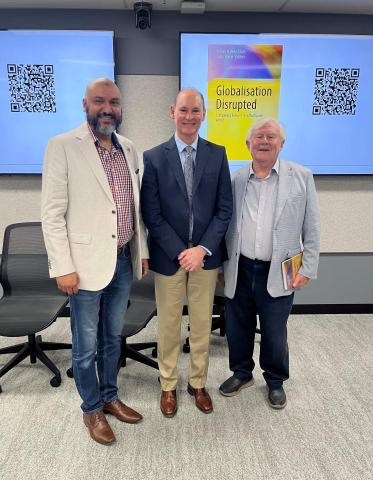
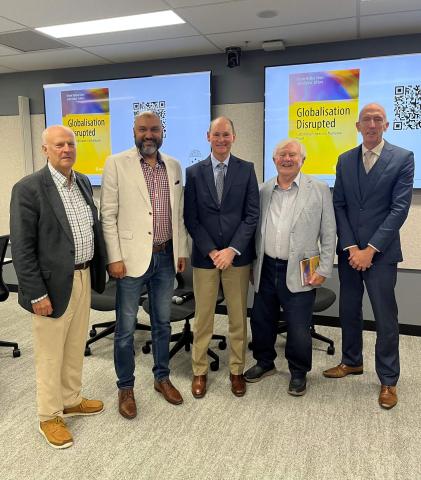
The launch of Globalisation Disrupted: Competing Futures in a Multipolar World at Bond Brisbane CBD was a well-received and timely event, bringing together a strong mix of academics, students, practitioners, and invited guests for an evening of discussion, reflection, and networking. Held at the newly refurbished Bond Brisbane on Level 26, 240 Queen Street, Brisbane CBD the event benefited from both an intellectually engaged audience and a striking city setting, with the Brisbane skyline providing an apt backdrop for a discussion about shifting global power, trade, technology, and Australia’s place in an increasingly contested international order.
Guests gathered in conversation before and after the formal proceedings, with several groups engaged in discussion around the room. The attendance featured a high degree of academic participation, alongside students and professionals, creating the kind of cross-generational and interdisciplinary audience that suits the book’s subject matter.
The keynote address by Professor Peter Draper, Executive Director of the Institute for International Trade and Director of the Jean Monnet Centre on Trade and Environment at the Adelaide University, formed the intellectual centrepiece of the launch. Professor Draper’s chapter, co-authored with Dr Nathan Gray, examines how Australia must adapt in a destabilising world marked by institutional weakness, rising protectionism, fragile supply chains, and geopolitical contestation. The chapter argues that Australia, as a middle power deeply reliant on international trade and investment, needs more resilient supply chains, diversified trade partnerships, stronger regional alliances, and policy frameworks capable of responding to a more fragmented global landscape. These themes clearly aligned with the launch’s stated purpose: to explore how the “tectonic plates” of globalisation are shifting and what this means for Australia.
The event was also timely because the book speaks directly to current anxieties in global economic governance. The introduction frames the present moment not as a simple collapse of globalisation, but as a complex process of re-making, driven by US–China rivalry, exposed supply-chain fragility, technological competition, resource nationalism, populism, and the rise of alternative institutional arrangements such as BRICS expansion, mega-regional agreements, and “friends clubs”. This framing gives the book immediate relevance for policymakers, scholars, students, and industry leaders trying to understand whether today’s disruptions are cyclical shocks, or signs of a deeper structural transition.
The conclusion reinforces that central argument by describing the current phase as “re-globalisation” or “re-made globalisation,” rather than straightforward de-globalisation. It argues that globalisation is not dead; rather, its form and vehicles are changing, with middle powers, regional groupings, mega-regionals, and plurilateral initiatives increasingly shaping the future of global governance. This message was especially appropriate for an Australian audience. Australia is not a great power, but it is not a passive observer either. The book positions middle powers as crucial actors in preserving openness, resilience, and rules-based cooperation in a world where traditional US-led multilateralism is under strain.
The launch therefore succeeded on two levels. First, it celebrated the publication of a significant scholarly contribution from Bond University and its contributors. Second, it created a forum for serious discussion about issues that are no longer abstract: tariffs, export controls, supply-chain security, critical minerals, digital trade, institutional paralysis, and the shifting role of middle powers. The visible engagement of attendees, the presence of students and academics, and the networking that followed the formal presentations suggest that the event was not merely ceremonial. It was a timely conversation about a world in transition.
The Bond Brisbane launch presented Globalisation Disrupted as a highly relevant intervention in current debates about trade, technology, geopolitics, and institutional change. The event’s strong attendance and engaged atmosphere reflected the urgency of the book’s subject and the growing interest in understanding how Australia can respond to a more fragmented, multipolar, and strategically competitive global order.