
Rising above
A serious paragliding accident midway through his degree drives Maverick to new heights

Outside, concrete-coloured skies press low over London. Inside, spotless stainless-steel benches mirror the harsh glare of fluorescent lights. There are few words, just the rhythmic tapping of knives on boards, the scrape of steel and the hiss of butter surrendering to heat. It is a place ruled by precision – and the pressure of cooking in the orbit of the most famous chef on the planet.
This is the new world Maverick Robbins will enter in March when he begins an intensive full-time culinary program at the Gordon Ramsay Academy in London. It is an unlikely setting for someone whose résumé reads more like an adventure film: surfer, scuba diver, freediver, kitesurfer, skydiver, paraglider.
So how does a sun-loving Hawaii-raised adrenaline-chaser with a Bachelor of Communication (Business) from Bond University end up swapping blue skies and warm water waves for British drizzle? The answer begins in the air.
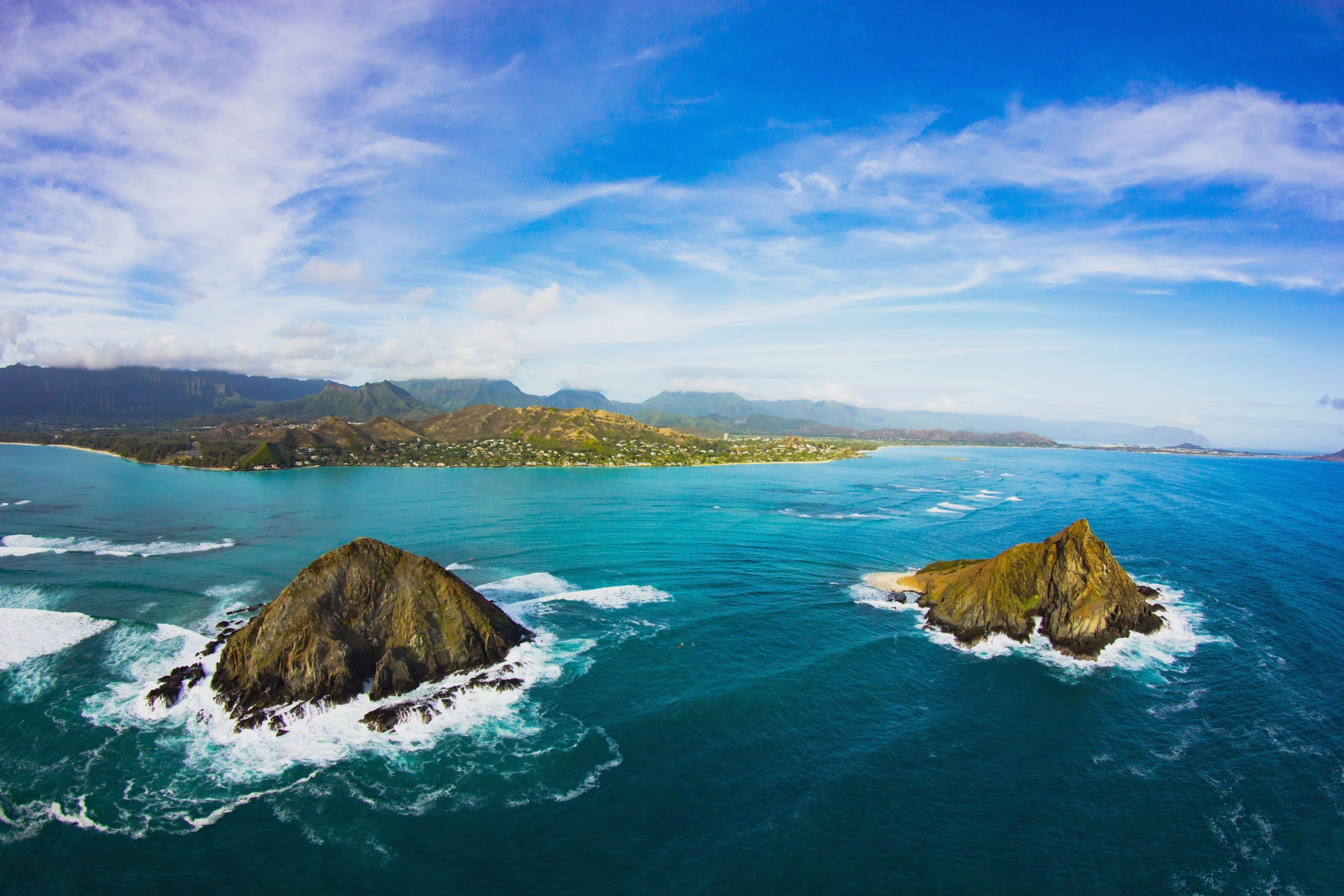
Maverick grew up on the island of O’ahu with adventurous parents and an open invitation to explore.
From a young age his days were spent in a sun-kissed and salt-encrusted world of water-based action sports – but at night his mind drifted to the skies.

Maverick grew up on the island of O’ahu with adventurous parents and an open invitation to explore.
From a young age his days were spent in a sun-kissed and salt-encrusted world of water-based action sports – but at night his mind drifted to the skies.

When you share a name with cinema’s most daring pilot, was there any other choice?
“I think we all have dreams of flying,” he says. “But for me, it was more of an obsession than a fascination.”
Hour after hour were devoted to redesigning paper aeroplanes to squeeze out a few more metres of flight. Commercial flights were spent with his forehead squashed against the window, imagining what it would feel like to move through the sky untethered.
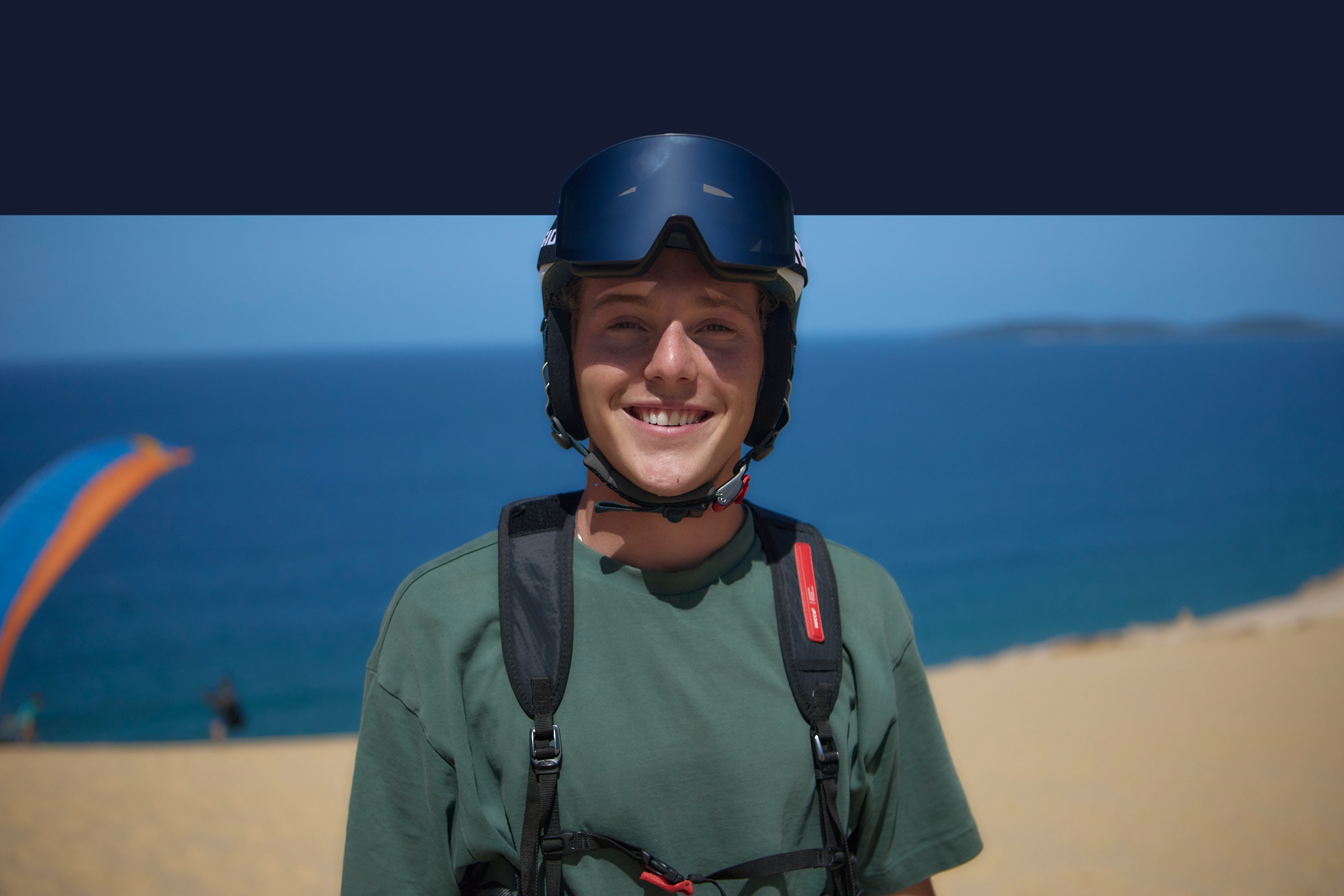
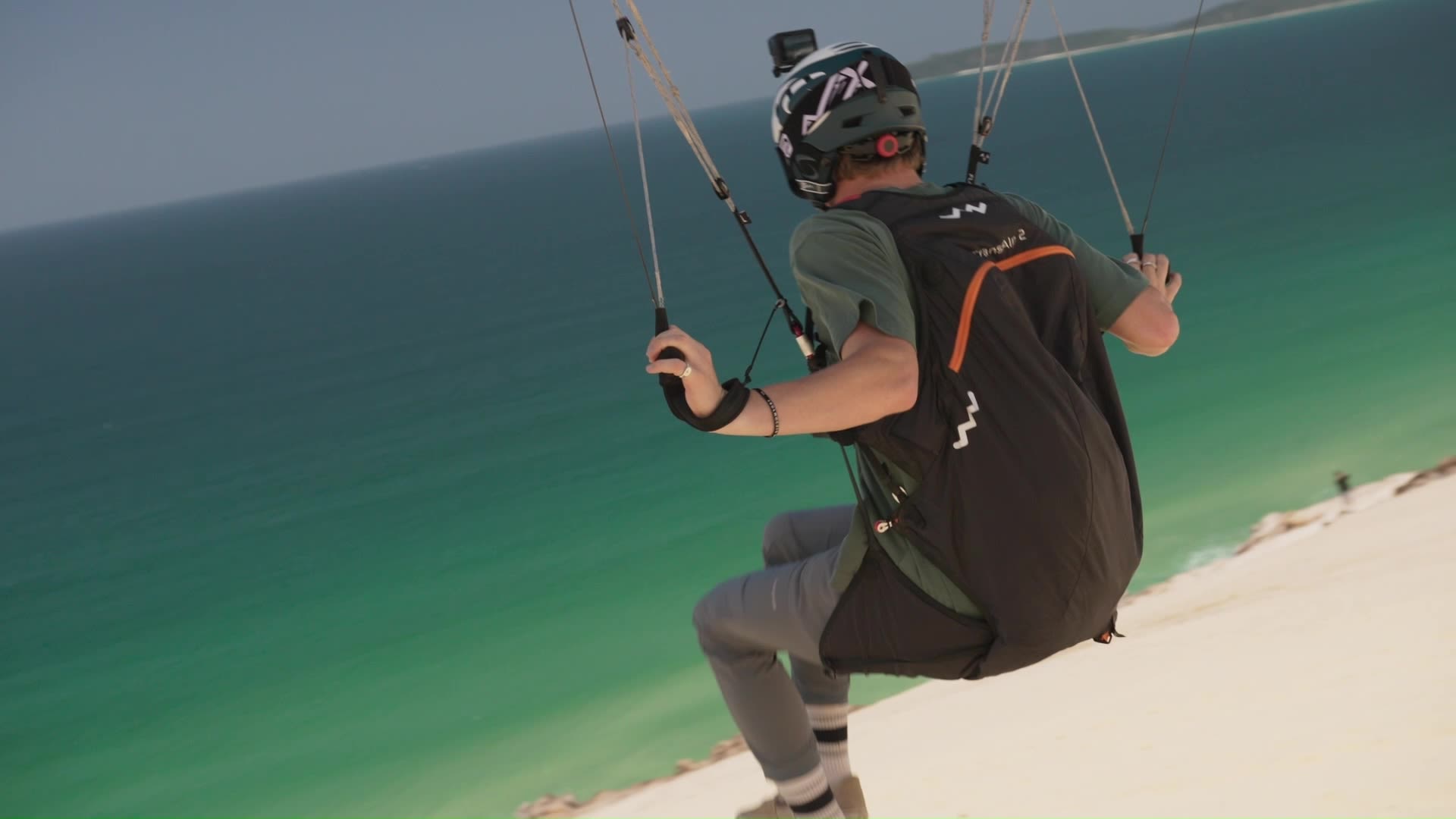
Six years ago, he started paragliding.
It felt like the fulfilment of something ancient and personal.

Six years ago, he started paragliding. It felt like the fulfilment of something ancient and personal.
No motor or fuel, just a wing and a harness, air currents and judgement. He logged hundreds of hours. And grew comfortable.
In October 2024, comfort gave way to consequence.
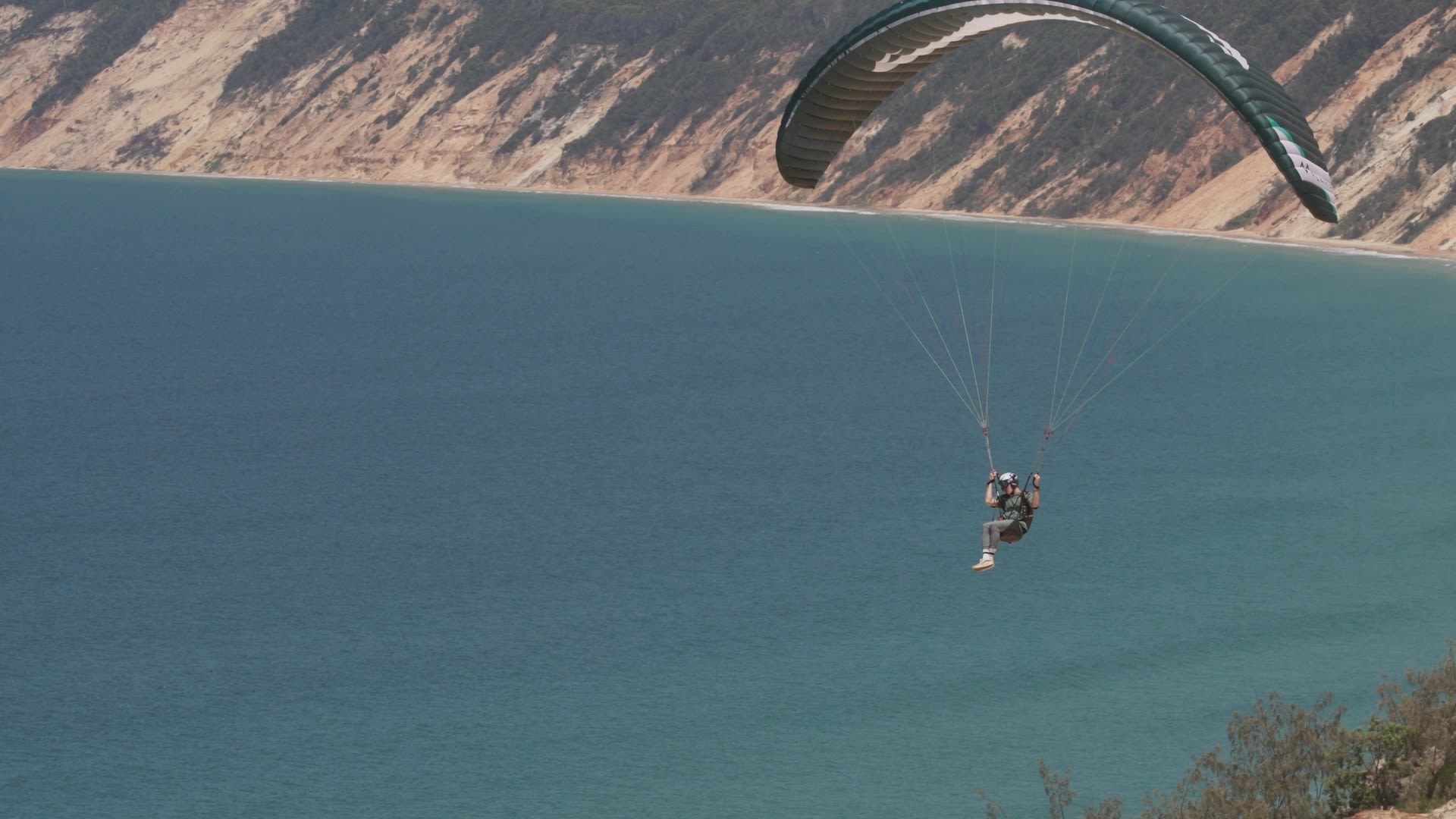
Rainbow Beach, wedged between the Cooloola Recreation Reserve and K’Gari on Queensland’s Sunshine Coast, is secluded and spectacular. The sandstone cliffs glow amber at sunset. The wind has to align perfectly to fly there.
On that particular day, the forecast looked promising. Maverick made a decision that now carries its own irony. He skipped his lectures at Bond and headed north with a mate, Vinny Brazier, telling himself he could watch the recordings later.
“I didn’t realise at the time that I would end up watching those lectures from a hospital trauma unit bed,” he said.
“There’s definitely a lesson in there about not skipping class.”
He flew for over an hour, repeating the same route along the cliffs. Just after sunset the wind shifted. He didn’t clock it.
When he turned back on the now-familiar line, there wasn’t enough lift. He hit the 100m sandstone cliff at full speed. In the seconds after impact, instinct and fear took over.
His lower body hung over a sandstone ledge. The pain in his back was excruciating; worse was the lack of feeling in his legs.
“My first fear was that I’d severed my spinal cord,” he says.
“My second was that the sand under me, and the shrub I was holding onto, would give way.”
His third fear was the remoteness. Would anyone reach him in time?
He dialled triple-0 and told the operator he needed a helicopter. An ambulance would never reach him.
Content warning: The following section contains audio of a 000 emergency call which some viewers may find distressing. If you need support, please contact Lifeline on 13 11 14.

Vinny landed nearby and scrambled to him. But pulling Maverick up risked shifting his spine or triggering a landslide. So, they waited – perched between sky and sea in fading light.
Hours later, the thrum of rotor blades announced help’s arrival.
Maverick watched the approach through the Flightradar app. On the other side of the world his anxious parents Chris and Christina did too.
That evening LifeFlight executed what pilot Aaron Regan, a 35-year-veteran, later described as one of their most technical rescues to date.
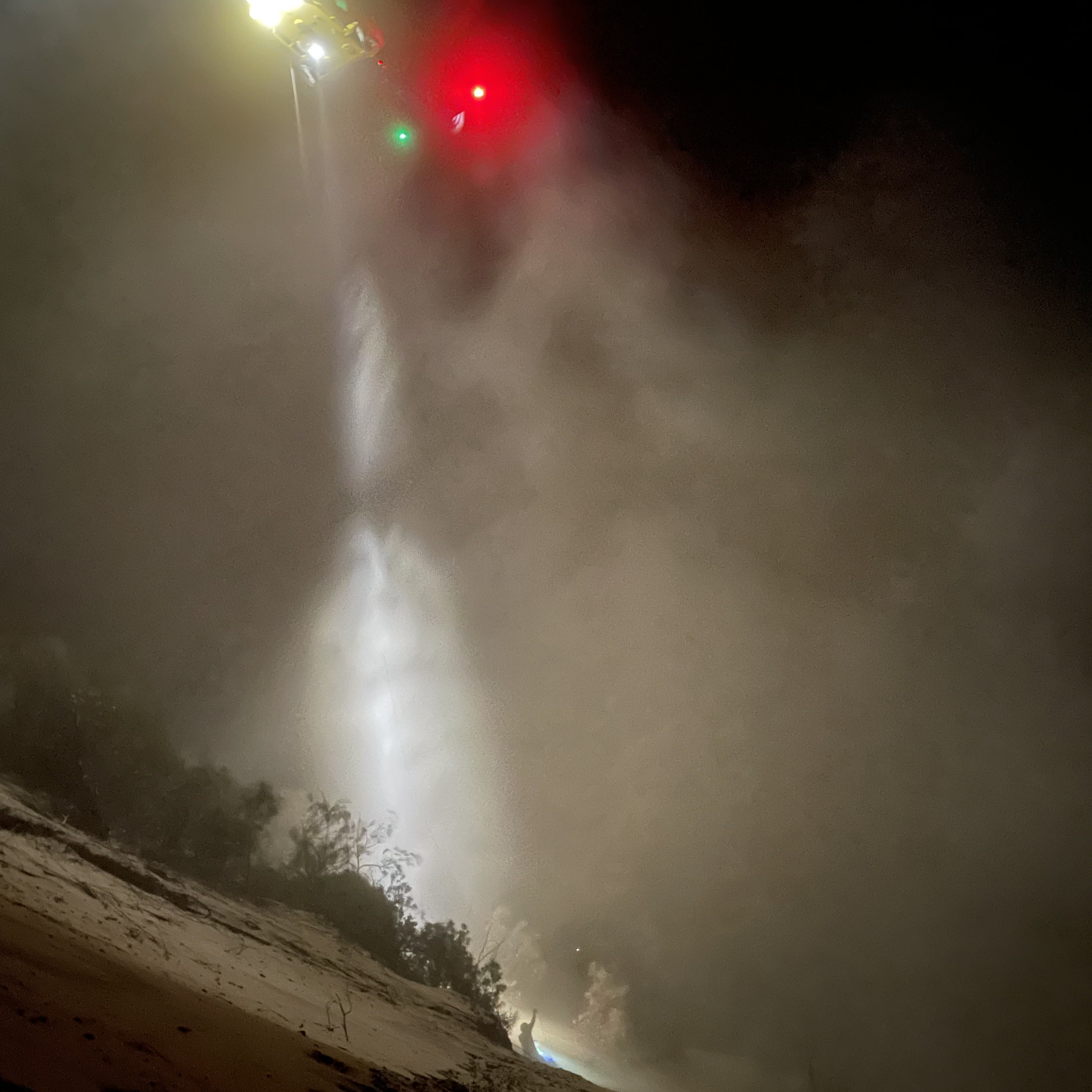
The sky was heavily clouded and moonless, visibility near zero. A firefighting crew from Tin Can Bay arrived at the top of the cliff in an off-road Polaris and guided Aaron in with lights.
The helicopter hovered 60m above the pair, about double the standard winching range, and carefully lowered a doctor and rescue crew down. Even at that distance the rotor wash threatened to destroy the fragile sand structure the group were perched upon.
The aircraft had to leave to refuel, then return.
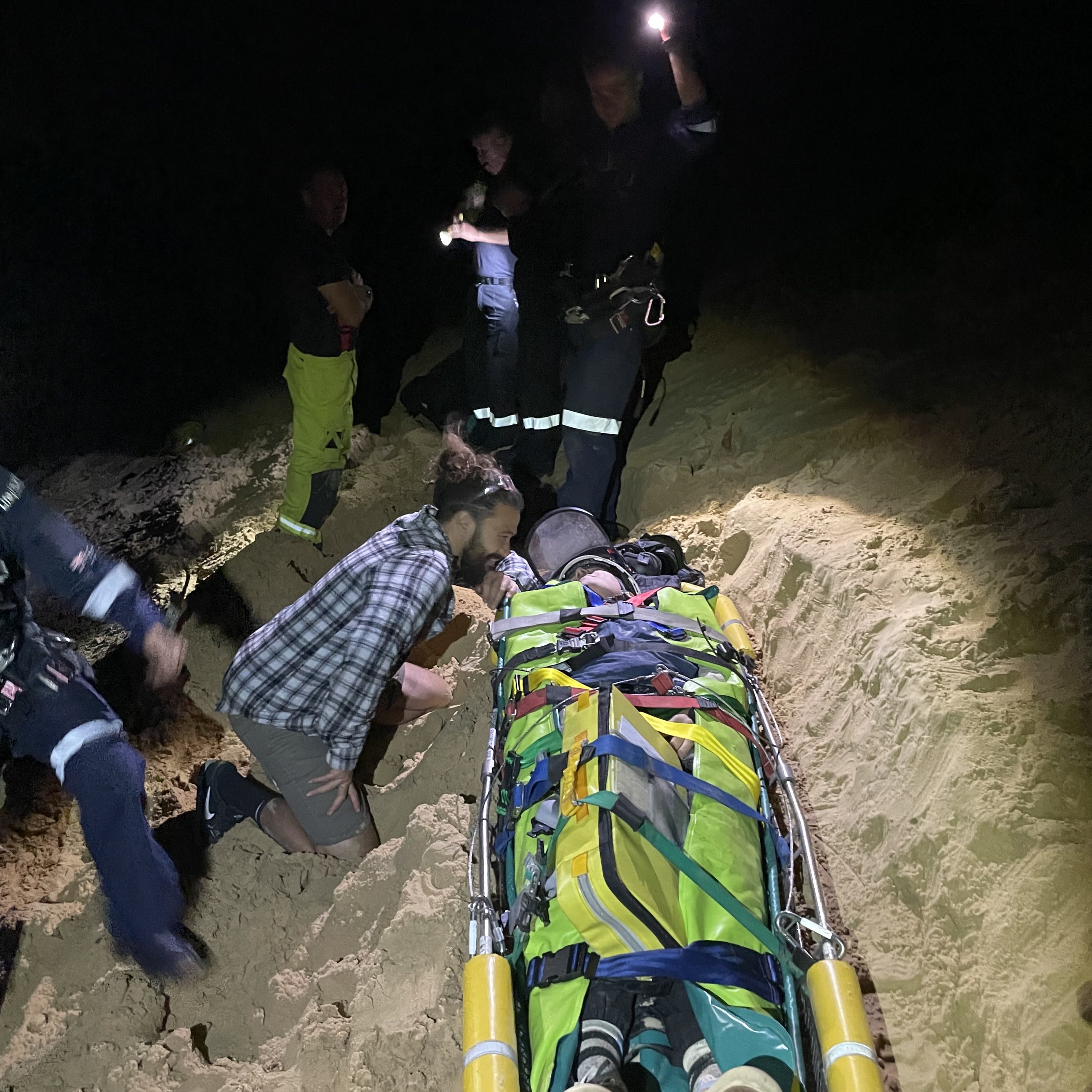
They extracted Maverick using the maximum cable length.
He will never forget it.
“I’ll always be grateful for the skill and professionalism of that crew,” he says.
“They got me out of the worst situation of my life.”
The injuries were severe: three spinal fractures - L1, L2 and T8. But there was no spinal cord damage. No paralysis.
He left hospital in a wheelchair.
“That was a formative and emotional moment,” he says.
“I knew I would walk again. And I promised myself I would never take my health or the ability to walk for granted.”
Recovery was physical and psychological. He felt guilt about the risk his rescuers had taken. Media coverage was patchy and at times sensationalised. Online criticism stung, with strangers declaring he had “got what he deserved” for participating in an extreme sport.
He learned not to internalise it.
“Many of those people have never experienced something so extraordinary that they were willing to take a real risk for,” he says.
But the accident did something else. It sharpened him.
“It gave me a stronger sense of gratitude and urgency,” he says.
“It made me realise how fragile life is and how important it is not to postpone what matters.”
In many ways, that urgency explains London.


The sky was heavily clouded and moonless, visibility near zero. A firefighting crew from Tin Can Bay arrived at the top of the cliff in an off-road Polaris and guided Aaron in with lights.
The helicopter hovered 60m above the pair, about double the standard winching range, and carefully lowered a doctor and rescue crew down. Even at that distance the rotor wash threatened to destroy the fragile sand structure the group were perched upon.
The aircraft had to leave to refuel, then return.
They extracted Maverick using the maximum cable length.
He will never forget it.
“I’ll always be grateful for the skill and professionalism of that crew,” he says.
“They got me out of the worst situation of my life.”
The injuries were severe: three spinal fractures - L1, L2 and T8. But there was no spinal cord damage. No paralysis.
He left hospital in a wheelchair.
“That was a formative and emotional moment,” he says.
“I knew I would walk again. And I promised myself I would never take my health or the ability to walk for granted.”
Recovery was physical and psychological. He felt guilt about the risk his rescuers had taken. Media coverage was patchy and at times sensationalised. Online criticism stung, with strangers declaring he had “got what he deserved” for participating in an extreme sport.
He learned not to internalise it.
“Many of those people have never experienced something so extraordinary that they were willing to take a real risk for,” he says.
But the accident did something else. It sharpened him.
“It gave me a stronger sense of gratitude and urgency,” he says.
“It made me realise how fragile life is and how important it is not to postpone what matters.”
In many ways, that urgency explains London.
Maverick’s path to Bond had been characteristically unconventional. As a surfer in Hawai’i, he once Googled “best universities for surfers.” UC Santa Barbara topped the list.
He enrolled and earned a spot on their highly competitive surf team. What the search hadn’t accounted for was the frigid water and early mornings wrestling into a thick, still-damp wetsuit.
After one semester, he refined the query: “best universities for surfers – warm water.” Bond University was at the top.
The Gold Coast offered warm surf, but it was Bond’s small class sizes that sealed the decision. He valued relationships with professors; some have offered continued support beyond graduation. During his degree, Maverick chose to step outside his comfort zone for his Capstone Project.
Rather than lean into the obvious territory of extreme sports, he created something unexpected: a video series called The Dinner Party Masterclass. The idea was rooted in childhood.
He grew up in a social household filled with long dinners and epic holiday parties. He saw how cooking created connection.
The series blended storytelling, instruction and warmth. It wasn’t about restaurant-level perfection. It was about confidence. About bringing people to the table.
“I wanted to show that hosting doesn’t have to be intimidating,” he said.
“It can be fun. It can build community.”

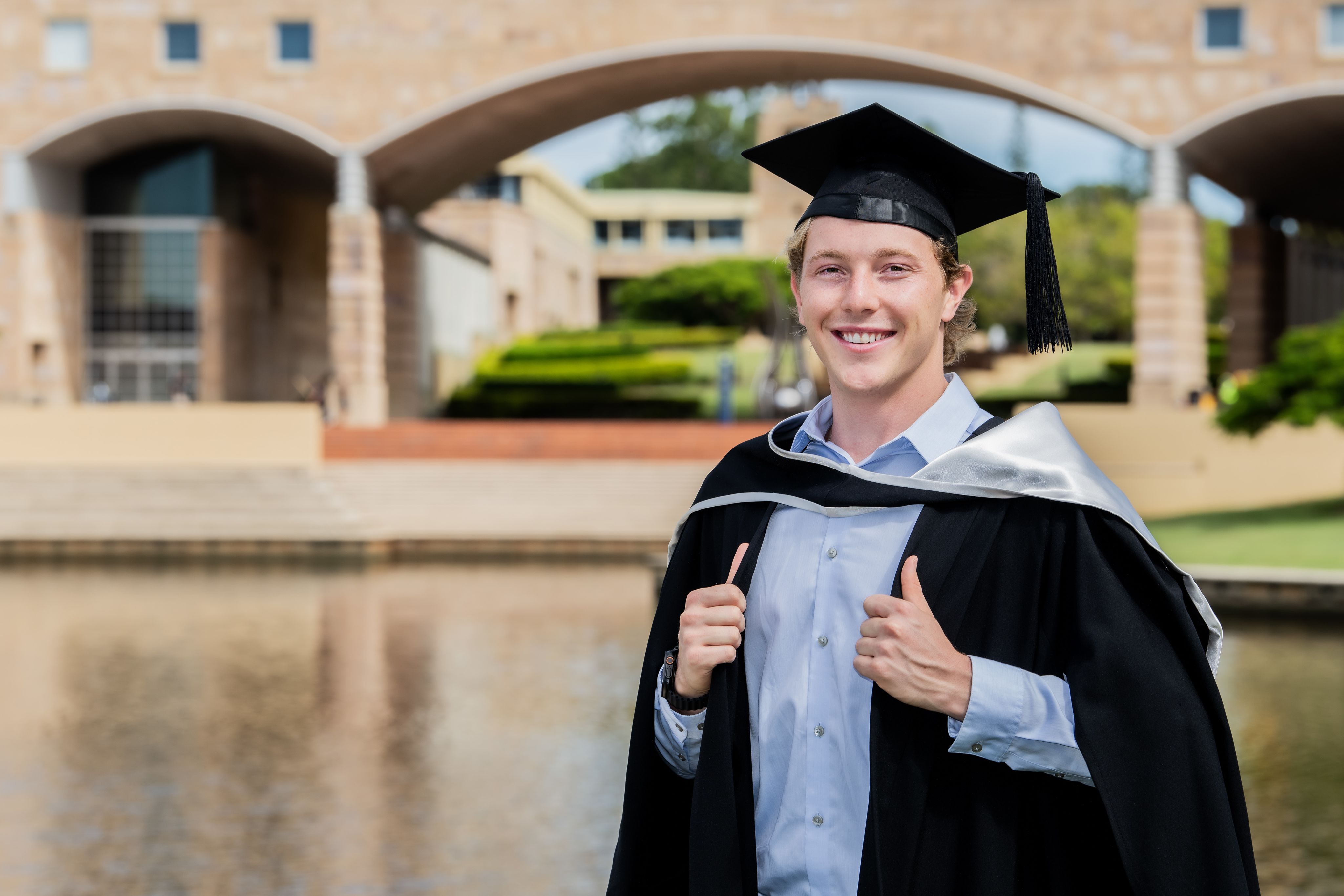
While the Dinner Party Masterclass hinted at his creative range, Maverick was already applying his Bond education in ambitious ways.
In 2024 he founded Island Fever, a bespoke extreme sports retreat that blends adventure, wellness and curated travel into a single high-end experience. The marketing and strategic communication skills he developed at Bond became the framework for building the brand from the ground up.
From identity and promotion to partnerships, client communication and content creation, every element drew directly on what he learned during his studies.
The inaugural Island Fever retreat in Hawaii attracted participants from North America, South America, Asia, Europe and Australia.
The program was unmistakably Maverick – skydiving, a private boat expedition to freedive with sharks, and highly specialised adventure and cultural experiences.
But beneath the adrenaline was careful strategy.

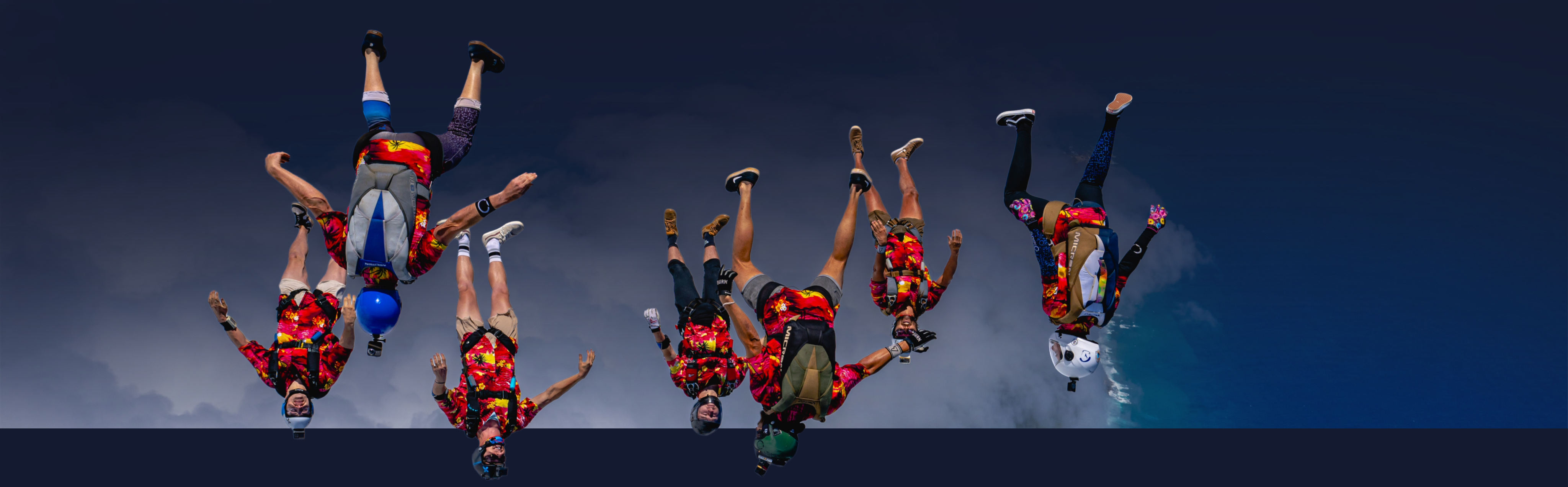
This year he is expanding the concept globally with Mountain Fever in the Slovenian Alps, Mediterranean Fever in Sardinia and a second Island Fever in Hawaii. Longer term, he envisages Safari Fever in Africa, Nordic Fever in Scandinavia and Andes Fever in South America.
Whether in the sky, in business or in the kitchen, Maverick is drawn to experiences that feel immersive and alive – that require risk and demand presence.
The accident recalibrated that relationship with risk.
He still flies with the encouragement of family, friends and even members of the rescue crew, but now with a more conservative eye. He has analysed the complacency that crept in that evening at Rainbow Beach.He understands the factors now and chooses conditions carefully. And he stopped postponing interests that had lingered on the periphery.
Cooking professionally was one of them.
Last summer he enrolled at The Avenue Culinary School in London. During his time in London he connected with chef Andrew Roberts, the Head Chef at the Gordon Ramsay Academy who encouraged him to apply for the 2026 program.
He did and was accepted. The year ahead is full.
After his graduation ceremony at Bond, he will return to London to continue culinary studies, then there’s coaching stints at international skydiving events, becoming a certified yoga instructor and backpacking through Peru to Machu Picchu with some fellow Bondies. What ties it all together is not adrenaline, but intention.
In the Academy kitchen, timing matters, temperature matters, attention matters. There is no autopilot.
This year he is expanding the concept globally with Mountain Fever in the Slovenian Alps, Mediterranean Fever in Sardinia and a second Island Fever in Hawaii. Longer term, he envisages Safari Fever in Africa, Nordic Fever in Scandinavia and Andes Fever in South America.
Whether in the sky, in business or in the kitchen, Maverick is drawn to experiences that feel immersive and alive – that require risk and demand presence.
The accident recalibrated that relationship with risk.
He still flies with the encouragement of family, friends and even members of the rescue crew, but now with a more conservative eye. He has analysed the complacency that crept in that evening at Rainbow Beach.He understands the factors now and chooses conditions carefully. And he stopped postponing interests that had lingered on the periphery.
Cooking professionally was one of them.
Last summer he enrolled at The Avenue Culinary School in London. During his time in London he connected with chef Andrew Roberts, the Head Chef at the Gordon Ramsay Academy who encouraged him to apply for the 2026 program.
He did and was accepted. The year ahead is full.
After his graduation ceremony at Bond, he will return to London to continue culinary studies, then there’s coaching stints at international skydiving events, becoming a certified yoga instructor and backpacking through Peru to Machu Picchu with some fellow Bondies. What ties it all together is not adrenaline, but intention.
In the Academy kitchen, timing matters, temperature matters, attention matters. There is no autopilot.
For Maverick Robbins, the crash at Rainbow Beach was almost a life-ending moment.
For Maverick Robbins, the crash at Rainbow Beach was almost a life-ending moment.
Instead, it became a life-changing one.

Instead, it became a life-changing one.

Original thinking direct to your inbox

Stories from Bond