Key points
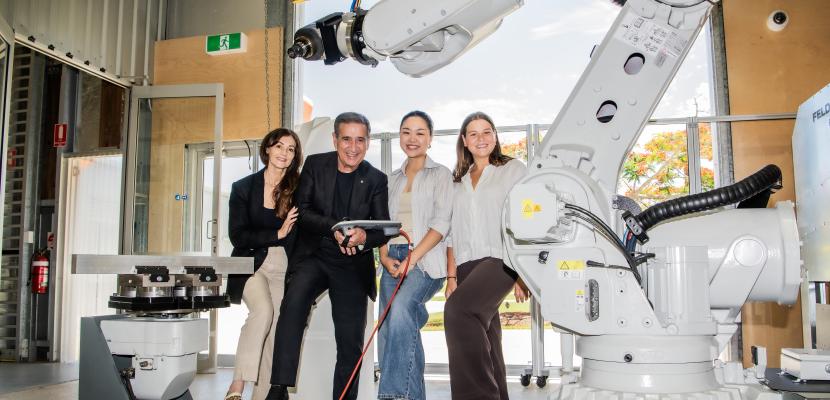
- Bond University has installed a world-first ABB fabrication robot in its Abedian School of Architecture.
- The robot offers industrial-grade precision and multi-tool functionality, similar to systems used by companies like Tesla and Ferrari.
- Students are using it to explore how automation is reshaping architecture, design and engineering workflows.
- The technology is intended to support innovation in sustainable construction and strengthen Bond’s global architecture program.
Bond University has unveiled a new fully integrated fabrication robot so advanced that counterparts operate at Tesla and Ferrari.
The ABB robot will be used by students and researchers at the university’s Abedian School of Architecture, helping them push the boundaries of construction and architectural innovation.
Head of the Abedian School of Architecture, Professor Paul Loh, said the robot would underpin several new subjects.
“There’s a massive opportunity for human-robot collaboration,” Professor Loh said.
“Students are learning the workflows behind automation – not just pushing a button.”
FabLab General Manager Ryan Wirth said the robot is fast and highly accurate, with capabilities far surpassing previous generations.
“This is the first one in Australia and one of the first off the production line with the other ones being scooped up by places like Ferrari and Tesla,” Mr Wirth said.
“To have something like this in a teaching institution in Australia is unbelievable.”
Tools that can feel, cut and build
The robot has a force-control sensor that allows it to physically ‘feel’ objects. A quick-change system enables it to swap between up to 20 tools, letting students experiment with cutting, machining, and drilling in ways previously possible only in industrial settings.
“Having access to this machine during an architecture degree gives students a huge advantage,” Mr Wirth said.
The robot was purchased with the support of Abedian School of Architecture patron Soheil Abedian AM.
The renowned Gold Coast developer said he hoped the acquisition would help cement the school as one of the best architecture programs in the world.
“In the fast-moving world of technology, the Abedian School of Architecture remains committed to our vision of architecture as an art form – creating and designing works that make the impossible possible through innovative tools such as the latest robotic arm,” Dr Abedian said.
“Technologies like this contribute to the advancement of the built environment, empowering the next generation of architects and designers with tools that will drive architectural excellence into the future.”
Student impact and changing design thinking
Master of Architecture student George Hickman said the hands-on experience had transformed how he thinks about design.
“To work with this tech team and to develop designs and see them realised through the machinery is amazing,” he said.
“Having the robots makes you realise there's not a hard boundary between architecture and other design or engineering professions, there's actually this fluid relationship between them.”
Associate Professor Kim Baber will use the robot in his research, transforming small trees that would normally be chipped, burned, or left to decompose into durable, unique structural elements.
He does this by crafting complex joints that only a master woodworker – or a precision robot – could achieve.
“The joints can be quite complex,” Dr Baber said.
“Using a robot like this allows us to take what would normally be classified as waste trees and turn them into structures that are very viable.”
A platform for future construction innovation
The robot is one of four available to Bond University architecture students and forms part of broader efforts to integrate automation into construction, an industry increasingly looking to robotics to address housing shortages and improve sustainability.