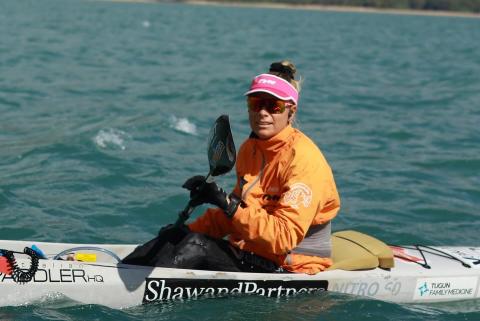
I love paddling. I actually love it so much, I paddled the whole way around Australia. It’s an amazing way to see the country but I think next time I might do the big lap from the comfort of a caravan…fewer sharks and crocodiles that way.
The experience taught me so much about paddling that I thought there was nothing more to learn. Last week, Olympic silver medallist Pierre van der Westhuyzen proved me very wrong.
The thing about paddling 12,700km on your own is you get very used to paddling solo. It’s just you, vast amounts of ocean in every direction you look and your support catamaran, sitting hundreds of metres away as it’s too dangerous to risk paddling too close to it while in an eight-kilogram carbon fibre ski. There’s something meditative about floating 500km offshore, admiring a sunset so vivid a photo would never do it justice.
Surf Lifesaving offers the opposite scenario. Over a five-minute ski race, chaos reigns supreme. The group of 16 paddlers line up, spread out over 40 metres, but by the time they’ve paddled the first 50 metres of the race, the group has funnelled into a tight pack only five metres wide. As they navigate the course, they must squeeze their six-metre skis around a set of cans, all the while facing whatever Mother Nature throws their way.
A ski being sent skywards by a 4ft shore dump, paddlers ducking their heads into a 20-knot wind or thousands of litres of water rushing across the gutter, sweeping the pack from right to left to right in a drastic fashion are all common occurrences.
I love the adrenaline rush that comes with paddling in the ocean. It’s the driving force behind the ten intense training sessions I complete each week. The feeling of launching over a huge wave and sprinting to make it over the next - it’s an electrifying, empowering feeling, and makes all of life’s stresses less significant.
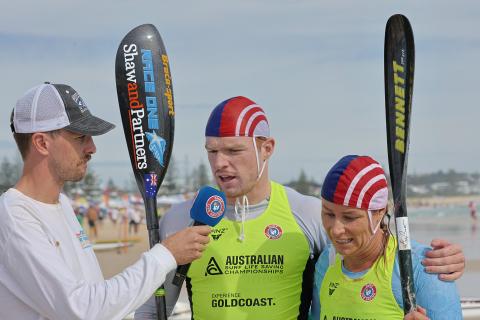
And once a year, I get the chance to try to etch my name into the history books when the Australian Surf Lifesaving Championships – better known as the Aussies - roll around.
At the age of 35, I’ve raced the Aussies 20 times, but this year was particularly special. I had the chance to do something totally new, that few people will ever get to experience - I got to paddle with an Olympic medallist.
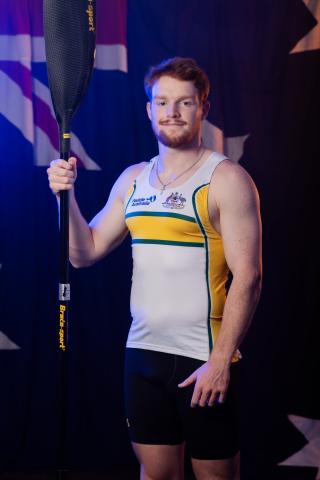
My teammate for the mixed double ski was Pierre van der Westhuyzen, the South African-born kayaker who won silver at the Paris 2024 games.
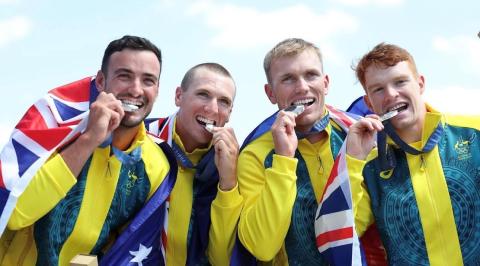
Combining with three other Surf Lifesavers in Riley Fitzsimmons, Jackson Collins and Noah Havard, Pierre helped the team power to the podium in the men’s K4 1000m race, narrowly losing a sprint finish to Germany by 0.04 seconds.
Though the race took less than two minutes, the silver medal represented ten years of work for the then-20-year-old Pierre, who was the youngest in the Australian kayaking team by a significant margin.
The K4 requires all paddlers to be in perfect synchronicity, as one slight lean in a paddler or choppy stroke can affect the plane of the craft through the water.
This makes Pierre an expert in team paddling, unlike me – who has only ever paddled in a double ski a handful of times.
Our mixed double ski race took place on Friday morning – day three of the Aussies - with the event starting with heats progressing to quarter-finals, semis and finishing with the final of 16 teams.
I arrived at the beach to see the back bank of North Kirra working, a 4ft bomb rolling through occasionally, taking out whichever poor soul happened to be in the wrong place at the wrong time. But there was enough of a gap between the sets that I knew we could navigate the ocean well, and maybe, just maybe, have a shot at the gold medal.
The mixed double ski race combines a male and female ski paddler from the same Surf Lifesaving Club – one paddler, generally the male, sits in the front of the 32-kilogram craft with the other paddler in the back seat.
Both paddlers must work as a team, with the front paddler steering the craft and setting the rating, the back paddler following the cadence of their teammate, and communicating information about the ocean in real time.
Pierre and I made our way towards the start line and well before a stroke was paddled, I learnt something.
Olympians carry an aura of calm that is felt by those around them. Walking to the start line, I felt more poised than ever before. Totally at ease despite the challenge ahead, I realised I was absorbing the supreme confidence held by my teammate, which can only be gained by racing on the world’s biggest stage.
The next observation was made ten seconds into the race, when I was nearly overwhelmed by the speed of the ski.
Pierre’s power output is immense. With each stroke, I could feel the ski being thrust forward, as I gritted my teeth to match his rating. This type of strength isn’t gained purely through paddling. It’s built, painfully, in the gym – with countless repetitions of weighted chin-ups a staple in the Australian kayaking programme.
But rather than the ski jolting along, the boat ran smoothly, gliding through the ocean despite the choppy water, powered by the effortless technique of my teammate.
By the time we crossed the line to qualify for the next heat, I felt a more complete paddler, who had learnt more in the last five minutes than in my two decades of paddling prior.
The quarter final was next and this time, I was ready for the pace off the start. Gripping my paddle tightly, I kept up...just. We progressed easily through to the semis in the no-fuss fashion I now realised was Pierre’s standard approach to racing.
By the time the semi-final came, the North Kirra bank had claimed several victims - teams who had faced Mother Nature’s wrath, hopes of an Aussie title destroyed by one rogue wave.
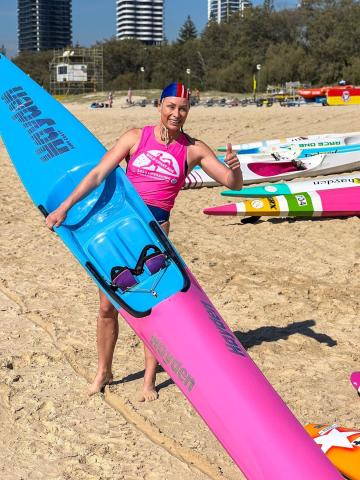
Unfortunately, the next victim was us.
After a strong start which placed us in the first group, we were soon humbled by a 4ft dumper which brought our speed to a stop and allowed the entire race a head start which couldn’t be caught.
This was the race where I learnt the most important lesson.
When we crossed in 11th, I was unsure how Pierre would react. I knew he would be disappointed like me, to have our medal hopes dashed so cruelly.
But rather than curse or throw his paddle, a scene which is witnessed all too often in various levels of sport, my teammate stood up and turned around to give me a hug.
At 22 years old, his first instinct was to reassure me after our loss.
This is when I realised that the true power of an Olympic medallist isn’t defined by their achievements, which will never be reached by 99% of the population.
It is defined by the qualities they possess when things don’t go to plan, when they don’t meet the goals they have spent every morning and evening working towards.
We may not all be able to win an Olympic medal, but to possess selflessness, resilience and humility – that’s something we can all strive for.