By Anthea Gerrard
Bringing Beer Law to Life: A Celebration of Craft, Community, and Conversation
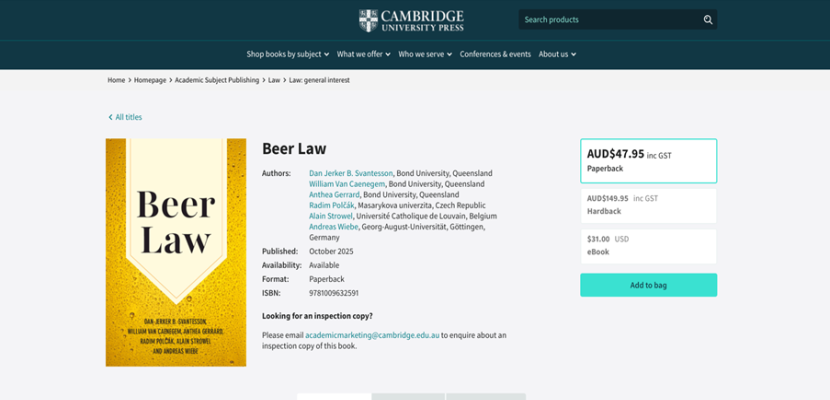
The launch of Beer Law (CUP, 2025) on Thursday, 20 November 2025 at Madocke Brewing in Ashmore marked the culmination of two years of dedicated research and scholarship by co-authors Professors Dan Svantesson, William van Caenegem, Anthea Gerrard, Radim Polčák, Alain Strowel and Andreas Wiebe. Their book ‘Beer Law’ is thought to be the first of its kind and brings together expertise in law, culture, and commerce to explore the fascinating legal landscape surrounding one of humanity’s oldest and most beloved beverages.
From intellectual property and trade regulations to taxation quirks, the speakers highlighted how beer intersects with law in ways few might imagine.
The birth of beer in Mesopotamia some 13,000 years ago has been said to be the start of ‘civilisation’. The thirst for beer persuaded hunter-gatherers in the Neolithic period to settle down long enough to domesticate wild barley used in the brewing process. Once settled, they never looked back!
While beer law hasn’t existed quite that long, it has certainly existed for centuries. Laws about beer appear in Hammurabi’s Code, the Magna Carta and most famously, the German Reinheitsgebot, which limited the ingredients in beer to water, barley and hops (and later yeast but not wheat).
The most obvious laws about beer, are taxes. Cleopatra first introduced beer taxes in ancient Egypt. Cleopatra claimed the laws were to combat the ill effects of drunkenness. She actually used the revenue raised to fund her wars against Rome. Many other politicians followed her example, relying on revenue raised from beer taxes to maintain or gain power. The preamble to the first English Excise Tax Act in 1643 specifically referred to taxes being used to maintain the “Forces raised for Defence”. Even today, the current Australian government has recently frozen the biannual increase in beer taxes on draught beer, to help with the cost-of-living crisis. Of course, this tweak helps their popularity, but they still raise billions of dollars per year from beer drinkers.
Beer was the perfect product for taxation. It was easy to make, inexpensive and consumed by many, so it provided a regular and secure revenue stream.
Beer was also used as a tax. For example, the tax for burying a body in ancient Mesopotamia was seven kegs of beer, a goat and a few other items.
Beer taxes were easily collected when the punishment for not paying the taxes was to have your right hand chopped off, as the brewers in the town of Aix-la-Chapelle (present-day Aachen in Germany) in the 13th century discovered! That is quite an incentive. Fortunately, we now have sophisticated computer systems to collect our taxes, but they are so high it sometimes feels as if your hands are held behind you, preventing you from living happily!
Being such a much loved and popular product, laws quickly developed around beer trademarks and copyright. There is still debate over who registered the first beer mark – was it the British Bass red triangle or the Czech Pilsner trademark or the Belgian Stella Artois? And in Ireland, when they separated from England in 1922, the government had to switch the direction of the iconic Irish harp so as not to infringe the Guinness trademark.
While there are many other laws considered in the book, there are also many “unwritten laws” or cultural traditions. Belgian beer culture, which is defined by traditionally broad varieties of beer, specific social institutions such as Trappist monasteries and the way beer is used in cooking and cheese-making, has been registered by UNESCO as a beer-related intangible asset. Other traditions are not so obviously recognised; nevertheless, they are followed religiously. One such example is the English tradition of “buying a round” – a practice that developed because the pubs were too small for everyone to go to the bar to order their beer. Instead, one person per table would do it and everyone would take turns. In the Nordic countries, drinking has always been important. Instead of celebrating Yule (Christmas), they would ‘drink Yule’. Even the nuns were given a beer allowance.
These cultural highlights were played out in a spirited debate between Dan and William over the superiority of Belgian versus Nordic beers. The audience was spared the task of declaring a winner, but the friendly rivalry added a delightful twist to the evening. Annelies Nijskens of Madocke rounded off the speeches with an impassioned plea for support of genuine independent breweries – having tasted her beers everybody present was all for it…
Over 50 attendees filled the brewery, creating an atmosphere that was equal parts scholarly and social. The venue itself, with its warm, rustic charm, set the perfect backdrop for an evening dedicated to craft beer and conversation. Guests were treated to an impressive selection of Madocke’s Belgian-inspired brews alongside wood-fired pizzas that paired beautifully with the theme of the night.
Beyond the speeches, the night was defined by lively conversation and laughter. Former colleagues reconnected, new friendships were forged, and the shared enthusiasm for both beer and law created a sense of collegiality that extended well beyond the brewery walls. The overwhelming support and engagement from attendees was a testament to the relevance and appeal of the book.
In the end, the launch of Beer Law was not just an academic milestone—it was a celebration of culture, craftsmanship, and connection. Great beer, great food, and even greater company made for an unforgettable evening. As the glasses clinked and conversations flowed, one thing became clear: beer may be governed by law, but it also has the power to bring people together in the most joyful of ways.