By Maughan Wellham
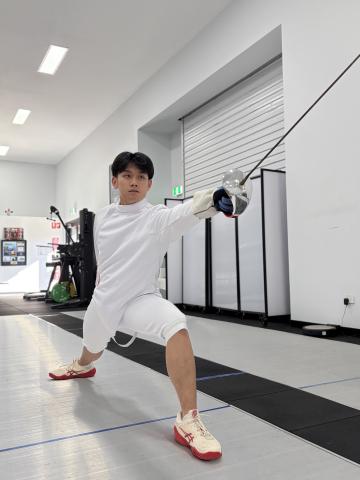
If there’s one thing elite fencing has taught Oscar Shi, it’s that outcomes are often settled long before the decisive blow lands.
Behind the mesh mask, hesitation is easy to hide.
But Shi has spent years learning how to spot it.
He watches for details others miss.
Sometimes, the tiniest movement tells him everything he needs to know.
“I notice patterns in how people move and anticipate what they’ll do next,” he says.
Sabre fencing has a reputation as the sport's most explosive event.
It’s a fast-paced discipline where points are scored with the edges of a fencer’s blade rather than the tip.
“I know competitors who are pretty hot-headed,” he says.
“The key is to keep your composure.”
At 20, Shi has relocated from Sydney to the Gold Coast to begin his first semester of a Bachelor of Medicine degree at Bond University.
It is the latest chapter in a journey that saw an unsuccessful junior soccer player turn towards a sport that would have him represent his country.
Shi claimed gold in the cadet men's sabre at the 2022 Commonwealth Fencing Championships and has since competed at the Championnats du Monde Juniors-Cadets - fencing’s premier junior world championship - against some of the world's best young fencers.
Despite competing in a sport built on explosive exchanges, that version of Shi isn’t the whole picture.
“I see myself as kind of a random guy,” he says.
“I like to keep a fairly loose mindset.
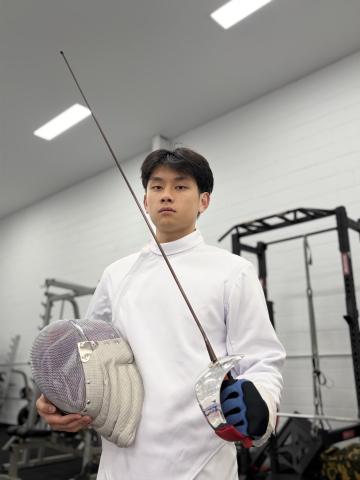
"But on the piste, it's like a switch flips. I can just dial in."
Studying medicine had long been an ambition for Shi. He was drawn to it a profession where he could contribute meaningfully to the lives of others.
Shi hopes the instincts honed on the piste will one day shape the doctor he becomes.
“When you’re working in medicine, people are relying on you. Families are counting on you,” he says.
“Fencing teaches you to make the right decisions under pressure.
"You're not going to win every bout.
“You learn how to work through setbacks and keep moving forward.”
Some lessons are arrived at the hard way.
One came courtesy of an ageing pair of fencing shoes.
Convinced they still had plenty of life left in them, Shi launched into an attack during a bout before losing his footing and sliding into the splits. Attempting to recover, he dislocated his shoulder.
He laughs about it now.
“It goes to show that you can prepare mentally and physically as much as you want, but you still need the right tools," he says.
"Sometimes you just need to invest in the right things."
It is an approach Shi has carried into medicine.
Bond's medical program appealed to him because of its accelerated structure, allowing him to step into clinical settings sooner.
"I like the fact that you can start practising earlier," he said.
The opportunity to undertake placements overseas was another drawcard.
"To practise medicine in another country would be such a valuable learning experience. Opportunities like that don’t come around very often for medical students," he said.
"You get to experience a different healthcare system and a different culture.
"I think seeing how medicine is practised elsewhere would make you a more well-rounded doctor."
While medicine may shape one side of his future, Shi has no intention of stepping away from the piste.
UniSport Nationals and the FISU World University Games sit firmly in his sights.
“The Olympics is the ultimate goal,” he says.
“But right now, my focus is on Worlds.”
The thought of representing Bond University against some of the world’s best student-athletes draws a significant smile.
If selection goes his way, South Korea could be the next destination fencing takes him, with the 2027 FISU Summer World University Games in Chungcheong scheduled for August.
If years spent reading opponents have taught Shi anything, it’s not to place limits on what comes next.
“I’ve seen Olympians who’ve had successful careers in medicine. Anything is possible.”