Days out from the Commonwealth Games swimming trials some of the most important work happens outside the pool.
While coaches sketch out training sets on whiteboards the swimmers, many of whom are Olympians and world champions, stride over to the wall and begin doing handstands and bridges.
To the small media pack that has assembled, it looks more like a gymnastics class, and the whir of camera shutters adds an extra layer of nerves to a squad that is starting to feel like Bull Sharks out of water.
But there’s method behind it all.
It’s what's known as a 'dry run' - a replication the pre-race routine they'll use at the trials over the weekend.
And they have one of best in the world leading them through it.
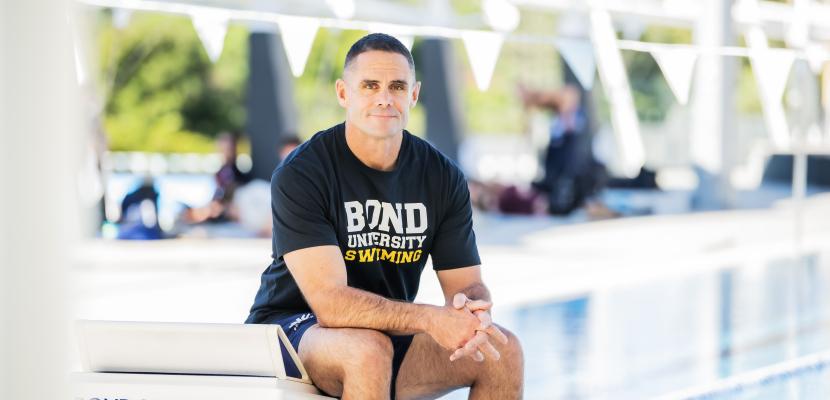
Strength and conditioning coach Dr Joseph Coyne has helped guide Chris Mooney’s charges since 2021.
His contribution to the squad and sports science more broadly has been so significant throughout that time the Faculty of Health Sciences and Medicine have this week awarded him an Honorary Adjunct Assistant Professor title.
Three times a week, Dr Coyne works with the swimmers on their explosive power and strength in the gym. He’s also the squad’s dive coach, responsible for maximising athletes’ explosiveness and technique off the blocks.
The concept behind the dry run is backed by years of sports science data and research.
“We’ll have two dry runs for the trials,” Dr Coyne said.
“Before getting in the pool, they’ll do hip and shoulder activation and then some closed chain shoulder work like handstands or bridges – I’m really big on gymnastics.
“After the swimming warm up, they’ll put warm clothes on as heat conservation is very important - losing heat can pretty much negate the warm-up.
“Five to ten minutes before going to the blocks, we do another prime to get them activated for explosive performance.”
Dr Coyne has good reason to understand the value of gymnastics for the swimmers.
He spent time working with the Chinese Olympic team in the lead up to the 2016 Rio de Janeiro games.
Observing some of the best coaches in the world fast-tracked Dr Coyne’s journey in elite sport.
“It was the biggest developmental period for me as a coach and practitioner,” Dr Coyne says.
“China brings in really successful expat coaches from around the world and just by osmosis you pick up all these little things about how athletes should be prepared.
“They are very successful in traditional events like weightlifting and gymnastics, and I learned a tremendous amount working across these sports.”
Dr Coyne says the most inspirational stories within sport don’t always involve the most talented athletes.
While in China, he had a front row seat to the evolution of 2022 world champion long jumper Wang Jianan.
“When he was 14 and in a sporting school in China and got dropped by his province as they didn’t think he had enough promise.
“But he kept at it and by the time he was 18, he won a junior world championship.
“A few years later, won the senior world championship on his last jump – to be told he wasn’t good enough and then to do that...it’s just a really inspiring story.’
After the Olympics, Dr Coyne worked with the UFC Performance Institute in Shanghai, before returned to Australia in 2016.
While working as Director of High-Performance Athletes and Sports Development at Lindisfarne College, he continued his studies, completing a PhD in the relationship between subjective training load and performance in open and closed skill sports.
The move to Bond in 2021 provided the perfect opportunity for Dr Coyne to combine a decade of knowledge in elite performance into a single discipline.
“I have pretty much always worked in centimetre, kilogram or second sports where performance is defined by how much you lift, or how far you jump,” he said.
“The strength and power work you do in the gym is much more relevant in those sports - the impact is pretty visible.
“Swimming is one of these sports - there is a direct correlation with strength work, which makes it really rewarding to coach in.
The recent recognition for his services to Bond is well-deserved, but Dr Coyne says the work is far from done.
“It’s really nice to be an adjunct at the university – the best part is helping out with research and mentoring the health science students.
“We have students come on pool deck and help us in the program, which I really rewarding.
“This whole space is a big team effort between my colleagues in the permanent staff and the students over at the Bond Institute of Health and Sport.”
The current research Dr Coyne is involved in has the potential to shape the future of elite athletic performance.
“My main interest right now is muscle fibre typology,” he said.
“You can do scans on the calf which give a pretty good idea of what type of athlete a person is – for example, you can have fast twitch fibre types who might be better dropping down in distance.”
“It influences the answer to the question – how do I apply a training load to them?
“I just find it so interesting.”